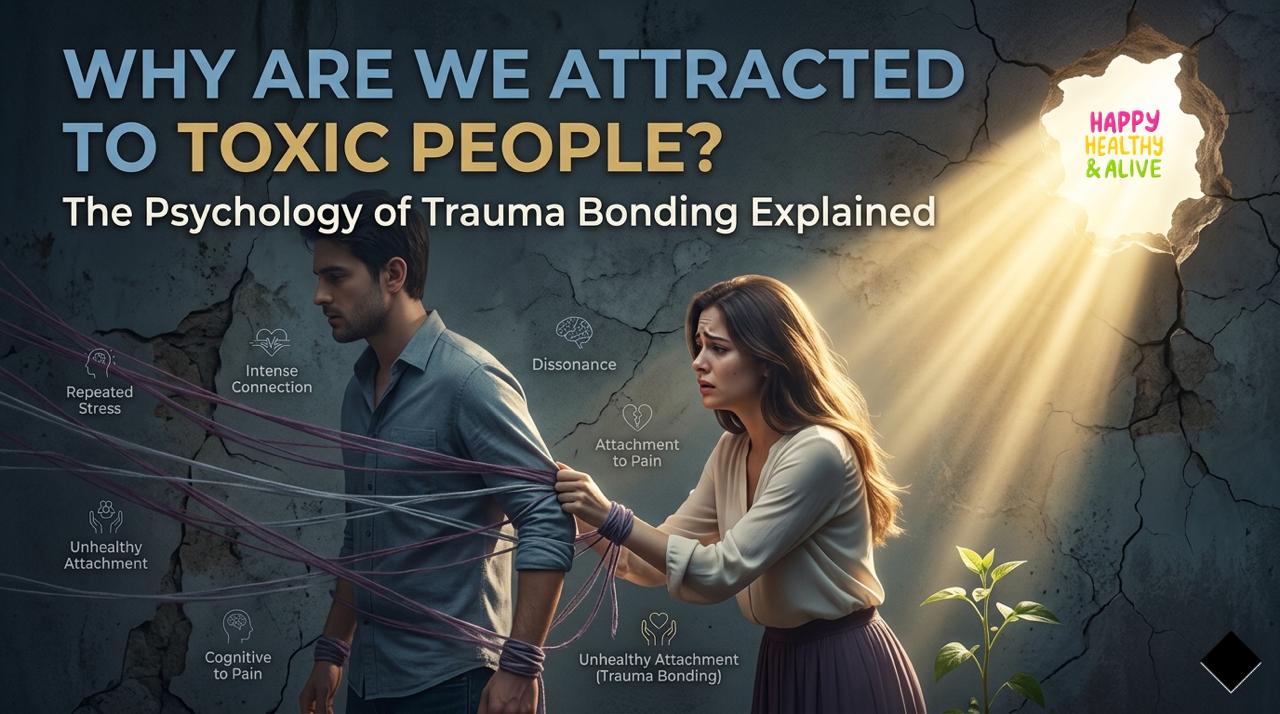
I) Why Do We Feel Drawn to People Who Hurt Us? Understanding Trauma Bonding
There is a question that quietly lives inside so many hearts, yet very few are able to answer it honestly.
Why do we feel such a deep pull towards someone who clearly hurts us?
Why does the attachment feel so strong, even when our mind knows that this connection is not right for our peace, our growth, or our life?
This is where the concept of trauma bonding begins to reveal its truth.
What Is Trauma Bonding in Simple Words?
Trauma bonding is not just an emotional weakness or a lack of control.
It is a psychological pattern where pain and affection get mixed in such a way that the bond starts feeling intense, meaningful, and almost impossible to break.
It is formed when someone gives you love, but not consistently.
There are moments of warmth, care, and attention, and then suddenly distance, confusion, or hurt.
This cycle of pain followed by affection creates a deep attachment that feels real, even though it is built on instability.
Why Intensity Feels Like Love (But Is Not)
Many people mistake this intensity for love.
They think that because the emotions are so strong, because the connection feels so consuming, it must be something deep and special.
But what if that intensity is not love at all?
What if it is simply your mind and body reacting to a pattern it has known before?
Why You Keep Going Back Even When It Hurts
This is why trauma bonding feels so confusing.
It does not feel logical, yet it feels powerful.
You may find yourself going back to the same person, holding on to the same connection, hoping that this time it will become what you always wanted it to be.
And somewhere inside, a deeper question starts forming, one that changes everything once you truly understand it.
If this connection is hurting me, then why does my own mind keep choosing it?
II) The Real Reason Your Brain Chooses Toxic Patterns (Science Behind Trauma Bonding)
To truly understand trauma bonding, you have to stop looking at it as an emotional mistake and start seeing it as a biological and psychological pattern.
Your brain is not randomly choosing pain.
It is following a system it was trained in, layer by layer, over time.
Let’s break this down clearly.
1. Your Brain is Designed for Survival, Not Happiness
The first truth that changes everything is this:
• Your brain does not choose what makes you happy.
• Your brain chooses what feels familiar and predictable.
From the brain’s perspective:
Familiar = Safe
Unfamiliar = Risky
So even if a relationship is painful, if it feels known, your brain will stay there instead of choosing something new that feels uncertain.
This is why people often choose familiar pain over unfamiliar peace.
2. Childhood Conditioning: Where the Pattern Begins
Most of these patterns are not created in adulthood. They are learned very early in life.
During childhood, especially between the ages of 0 to 7:
The brain is highly programmable
Experiences directly shape neural pathways
If a child experiences:
• Love mixed with inconsistency
• Attention mixed with neglect
• Care mixed with emotional stress
Then the brain learns one powerful equation:
Love and pain belong together
This becomes the internal blueprint for future relationships.
3. How Childhood Shapes Your Attraction Patterns
There is a core neuroscience principle:
Neuron’s that fire together wire together
If love and pain are experienced at the same time repeatedly, the brain connects them permanently.
This means:
• Feeling love can automatically trigger anxiety
• Feeling pain can increase emotional attachment
This is not a conscious choice. It is a wired response.
4. Dopamine and Intermittent Reinforcement (Addiction Loop)
This is one of the strongest forces behind trauma bonding.
Toxic relationships often follow a pattern:
• Withdrawal or hurt
• Followed by sudden affection or attention
This creates something called intermittent reinforcement, which is also used in gambling systems.
Why Toxic Love Feels Addictive (Dopamine Effect)
Why it is powerful:
• Predictable rewards feel normal
• Unpredictable rewards create obsession
Every time affection comes after pain:
• Dopamine spikes in the brain
• The brain starts craving the next “reward”
You are not just emotionally attached.
You are neurologically conditioned to chase that cycles
5. What “Intensity” Really Means (Scientific Understanding)
Many people say, “I feel intense love.”
But scientifically, intensity is not love.
Intensity is high nervous system activation
It includes:
• Increased heart rate
• Stress hormones like cortisol
• Dopamine spikes
• Emotional hyper-focus
This means your body is in a state of arousal, not peace.
The important truth is: Your brain often confuses emotional arousal with attraction
So what feels like deep love can actually be: Anxiety mixed with excitement
6. Your Brain as a Prediction Machine
Your brain constantly tries to predict what will happen next.
Familiar patterns help it:
• Save energy
• Feel in control
So even if the pattern is painful, your brain prefers it because it knows how it works.
That is why: Predictable pain feels easier than unpredictable peace
7. Emotional Brain vs Logical Brain (Internal Conflict)
Inside your brain, two systems are working:
• Limbic system: Emotional, fast, reactive
• Prefrontal cortex: Logical, slow, rational
In trauma bonding:
• The emotional brain becomes dominant
• The logical brain gets suppressed
That is why you can clearly think: “This is not right”
And still feel: “I cannot let go”
8. Repetition Compulsion: Trying to Heal the Past
There is a psychological pattern where the mind tries to recreate old emotional wounds.
Not to suffer, but to fix them.
If you felt:
• Ignored
• Unseen
• Unchosen
Then you may be drawn to someone who reflects the same pattern.
Deep inside, the mind believes: “If I can make this person love me, I will finally heal”
But instead of healing, the same wound keeps repeating.
“So you are not in love with him or her, you are in love with yours fairy tale perception of him or her.
And to put it brutally, you are in love with your own lack mindset, not with him or her or with his or her qualities.
So wake up to reality.”
III) The Truth That Changes Everything: You Are Not Attached to the Person
After understanding the science behind trauma bonding, a deeper realisation begins to form.
The attachment you feel is not really about the person in front of you.
It is about something much older, something much more personal, and something that has been living inside you for a long time.
Let’s break this truth gently, but honestly.
1. You Are Attached to a Familiar Feeling, Not the Person
What feels like love is often a recognition of a familiar emotional pattern.
• You are not just seeing them as they are.
• You are experiencing how they make you feel.
And that feeling is often:
• Known
• Repeated
• Deeply wired within you
This is why even when someone hurts you, your mind still pulls you back.
Because it says: “I have felt this before, I know this space”
Familiarity creates attachment, even if it is painful.
2. You Are Holding an Unfinished Emotional Story
The attachment is not just about the present moment.
It is connected to something incomplete from your past.
You are holding:
• The hope of finally being chosen
• The desire to feel enough
• The need to receive consistent love
• This creates an inner belief:
“Maybe this time, it will be different”
So you stay, not because of what is happening, but because of what you wish could happen.
3. Identity Attachment: “This Feels Like Love to Me”
Over time, your experiences shape your definition of love.
If love once felt:
• Unstable
• Conditional
• Unpredictable
Then your mind starts accepting:
“This is what love feels like”
So when a similar pattern appears again, it feels intense, real, and important.
But here is the shift:
• Familiar does not mean right
• Intensity does not mean love
It only means your system recognises the pattern.
4. The Deeper Root: Childhood and the Role of Parenting
This is where the truth becomes more awakening, not just for individuals, but for families and society.
•These patterns are not created in your teenage years.
• They begin much earlier, when you are too young to even understand what is happening.
The Hidden Role of Childhood in Toxic Attraction
A child learns love through:
• The way they are spoken to
• The consistency of care they receive
• The emotional environment they grow up in
If that environment carries:
• Confusion
• Emotional inconsistency
• Conditional affection
Then the child unknowingly absorbs:
And this becomes the foundation of future attachments.
️ 5. What Was Different in Satyuga and Purer Eras
In earlier times, especially in Satyuga and other purer eras, the approach to bringing a child into this world was very different.
Children were not born casually.
They were welcomed with awareness, responsibility, and spiritual understanding.
Practices like Garbha Sanskar existed, where:
• The child’s consciousness was nurtured even before birth
• Parents focused on purity of thoughts, emotions, and environment
Children were raised with:
• Stability
• Unconditional love
• Strong values and emotional clarity
Because of this: Their internal patterns of love were pure and balanced
That is why such deep trauma-based attachments were far less common.
IV) How to Break Trauma Bonding: Rewiring Your Brain, Not Just Your Emotions
Once you truly understand trauma bonding, one thing becomes very clear.
This is not just about leaving a person or controlling your feelings.
This is about rewiring a pattern that your brain has been following for years.
And that is why simple advice like “just move on” or “just let go” never works.
You are not weak.
You are working against conditioning, chemistry, and emotional memory.
The good news is that what was learned can also be unlearned.
But it has to be done consciously.
1. Break the Illusion Loop by Seeing Reality Clearly
The first step is to stop feeding the false image your brain has created.
In trauma bonding, your mind often highlights:
• The good moments
• The potential of the person
• The hope of what it could become
And it hides:
• The repeated hurt
• The inconsistency
• The emotional cost
To break this loop:
Write down every moment where you felt disrespected, ignored, or hurt
Read it when your mind tries to romanticize the connection
This is not about blaming the other person.
This is about helping your brain update its understanding of reality.
2. Separate Your Inner Child from Your Present Self
Not every emotion you feel belongs to your present situation.
Sometimes, what you feel is an old wound speaking.
When you feel:
• “I need them”
• “I cannot lose them”
Pause and ask yourself:
“Is this my present self speaking, or a younger part of me seeking love?”
This small awareness creates a powerful shift.
It helps you respond instead of react.
3. Train Your Nervous System to Accept Calm Love
One of the most confusing parts of healing is this:
Healthy love may initially feel unfamiliar or even boring.
Because your system is used to:
High intensity
Emotional highs and lows
Constant stimulation
So when you experience:
Stability
Consistency
Peace
Your mind may think: “Something is missing”
But the truth is:
Nothing is missing. Chaos is missing.
You have to gently train your system to recognize that:
Peace is safe
Consistency is real love
4. Stop Trusting Familiarity, Start Choosing Safety
For a long time, your choices may have been guided by what feels known.
Now, you have to shift that standard.
Instead of asking: “Does this feel familiar?”
Start asking: “Does this feel emotionally safe, divine and respectful?”
This one shift rewires your decision-making process.
Because:
• Familiar patterns come from the past
• Safe patterns create your future
5. Redefine Detachment: It Is Not Loss, It Is Alignment
Detachment often feels like losing something important.
But in reality, it is a correction.
You are not losing love.
You are releasing a pattern that was never truly supporting you.
Detachment means:
• Choosing clarity over confusion
• Choosing self-respect over emotional dependency
• Choosing long-term peace over short-term intensity
And this is where real strength begins.
V) Tools That Actually Help You Heal: Supporting Your Brain Through the Detachment Process
By now, one truth should feel very clear inside you.
Healing from trauma bonding is not just emotional strength.
It is a process of supporting your brain, your body, and your patterns in a new direction.
And while awareness is powerful, the right tools can make this journey more stable, grounded, and real in your daily life.
Tools That Make Healing Easier and Practical
These are not random suggestions. These are practical supports that align directly with how your brain actually works.
1. Journaling for Pattern Awareness and Emotional Clarity
When your mind is caught in a trauma bond, it often loops the same thoughts again and again without clarity.
A structured journaling practice helps you:
Separate facts from emotional assumptions
Track repeated patterns in your relationships
Build awareness of your triggers and reactions
A simple tool like the The Five Minute Journal can be used not just for gratitude, but also to:
Write your emotional patterns daily
• Reflect on moments where you felt triggered
• Reinforce what is real instead of what feels intense
• This helps your brain slowly shift from confusion to clarity.
2. Nervous System Regulation Through Meditation
As you learned earlier, trauma bonding is deeply connected to nervous system activation.
So calming your system is not optional.
It is necessary.
Using guided practices on apps like Insight Timer can help you:
• Reduce emotional reactivity
• Move out of constant stress response
• Feel safe in stillness and calmness
This directly supports your brain in accepting peace over intensity.
3. Deep Understanding Through Trauma Psychology
Sometimes, healing becomes stronger when you intellectually understand what you are experiencing.
Reading a book like The Body Keeps the Score can help you:
See how trauma is stored in the body
Understand why emotional patterns feel so strong
Realise that your reactions have a biological base
This removes self-blame and replaces it with awareness.
4. Releasing Stored Emotions Through the Body
Trauma is not just in your thoughts.
It is also stored in your body.
Gentle physical practices using tools like TheraBand Resistance Bands Set can support:
• Movement-based emotional release
• Reduction of stored tension
•Better connection with your body
This is called somatic healing, and it helps complete the emotional cycles your mind alone cannot.
5. Training Your Brain Towards Calm and Focus
Since your brain has been wired towards stress and intensity, it needs support to experience something different.
Devices like Muse S Headband Meditation Device can help you:
Train your brain to stay in calm states
Become aware of your mental patterns in real time
Build consistency in emotional regulation
This is not about depending on tools.
It is about guiding your brain towards a new baseline.
Bringing It All Together: A New Understanding of Love
At the end of this journey, one realization becomes deeply important.
Your brain is not wrong for feeling attached.
It simply followed the patterns it was given.
But now, you are aware.
And awareness gives you a new choice.
You can continue choosing what feels familiar.
Or you can start choosing what truly supports your peace, your growth, and your soul.
Because real love will not confuse you.
It will not exhaust you.
It will not make you question your worth.
It will feel steady, safe, and clear.
Final Closure
You were never weak for holding on
you were simply repeating a pattern your mind once learned.
And healing begins the moment you stop choosing what feels familiar…
and start choosing what feels truly right for your being.
The day you stop calling chaos “love” is the day your soul finally begins to feel at home.