Fear is one of the most powerful forces shaping human life — yet very few of us pause to ask where does fear come from in the first place.
We assume fear is just “how we are,” part of our personality, or proof that something is dangerous.
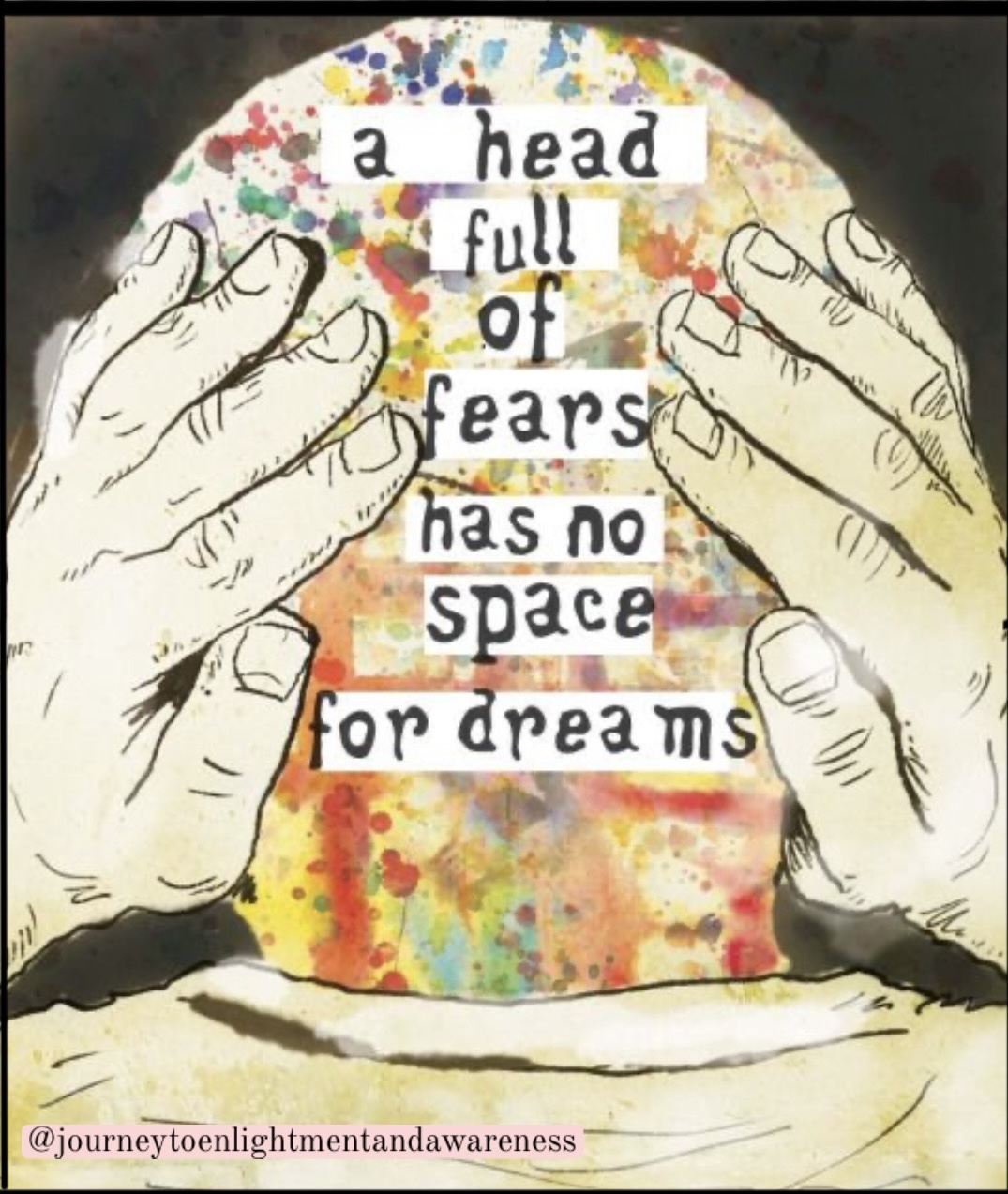
But what if much of the fear we carry was not born with us… but slowly taught to us?
Before we try to conquer fear, we need to understand it.
Because fear does not only arise from real threats — it is also built through childhood experiences, parental guidance, social conditioning, and repeated beliefs that quietly settle into our subconscious.
And once fear becomes a belief, it begins shaping our decisions, our confidence, and even the limits we think we have in life.
This is not a story about fear being an enemy.
It is a story about how fear is formed — and how awareness can gently loosen its hold.
Where Does Fear Come From —Are We Born With It or Do We Learn It?
From the very beginning of life, fear plays a role — not as something negative, but as a built-in survival signal.
Even babies show fear responses before they ever learn words or logic.
Loud noises make them startle, being separated from their mother triggers distress, or a sudden fall causes immediate crying.
These reactions are not learned from parents or teachers — they’re biological. They are part of a built-in safety system that helps us stay alive.
This instinctive fear is not about anxiety or worry yet.
It’s the body’s way of saying, “Pay attention — something here might require caution.”
It’s an early warning system that exists in all mammals, not just humans.
So yes, fear in this pure form is part of our nature — it keeps us safe, alert, and responsive to danger we can see and experience in the present moment.
How Childhood Experiences Shape Fear in Adults?
But then something else begins to happen as we grow up: we start learning fear from the world around us.
Very early in life, we are introduced to not just instinctive fear, but acquired fear — the kind that stays long after the initial experience.
Parents say things like, “Don’t touch the fire, it will burn you,” or “Look both ways before crossing.”
At first, these are practical warnings.
But over time, they become internalized beliefs about danger.
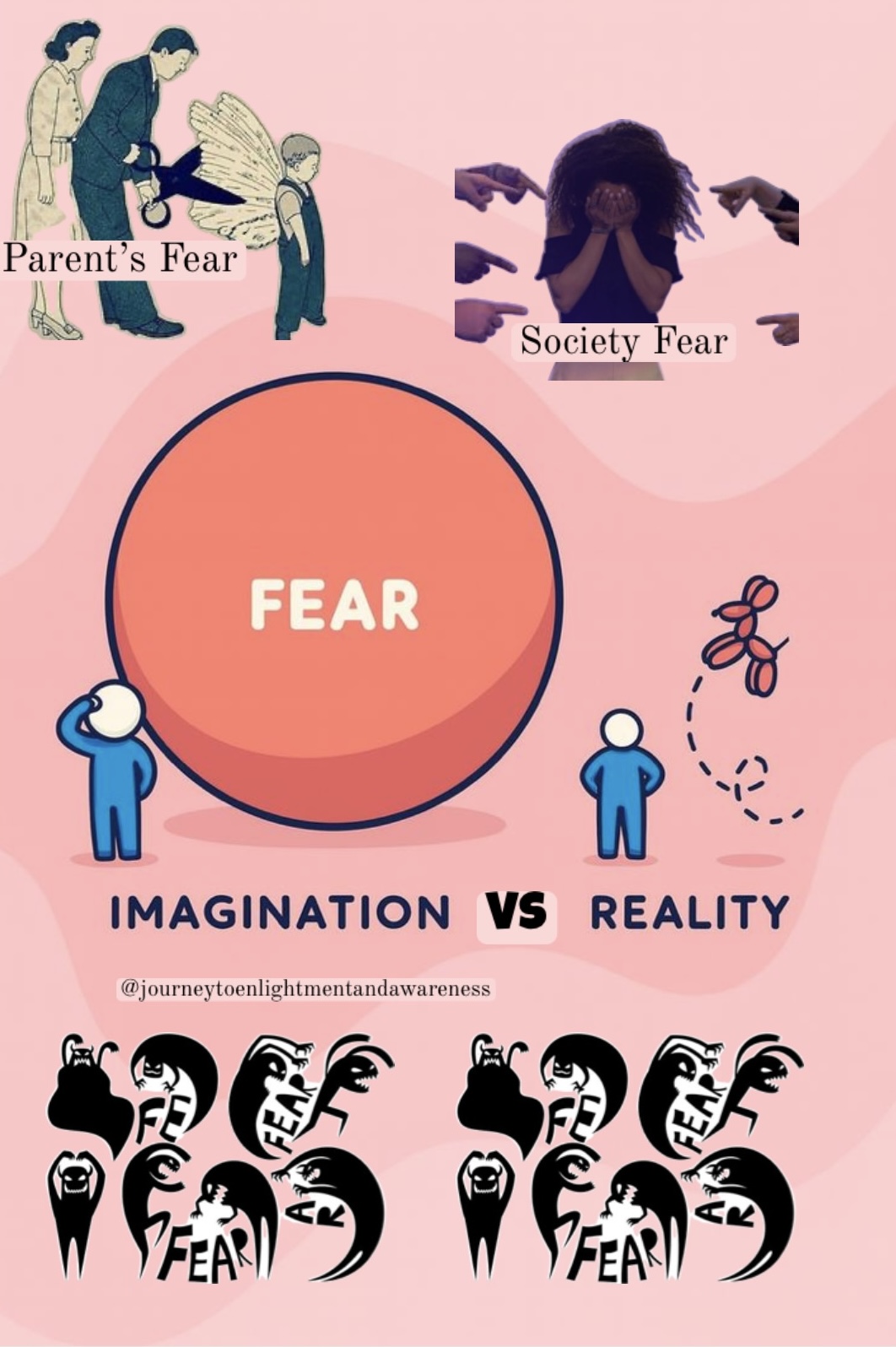
Then teachers, friends, society, and media add more layers: fear of failure, fear of embarrassment, fear of rejection, fear of judgment, fear of not being enough.
Unlike biological fear — which comes directly from physical danger — these learned fears are shaped by words, stories, culture, and meaning.
They stay with us because they become part of our inner language:
“What if I fail?”
“What will they think?”
“What if this goes wrong?”
So while we are not born with these fears, we gradually absorb them from the world — not because they are inherently true, but because we have been conditioned to believe that safety lies in avoiding pain, discomfort, and disapproval.
This is why two people can be raised in slightly different environments and develop entirely different fear responses.
One might see challenge and growth, another sees threat and danger — even when the situation is very similar.
That’s the mind in action: learning fear from culture, language, and experience, and then running it on repeat inside us.
How Do Parents Influence a Child’s Fear and Confidence?
One of the biggest influences on whether a child grows up confident or fearful is the environment created at home.
Parents don’t just raise children through food, school, and routines — they shape a child’s inner world through tone, reactions, and repeated messages.
A child does not come into the world afraid of life itself.
But slowly, through daily interactions, they begin to understand whether the world is a safe place to explore or a dangerous place to constantly guard against.
Often, fear is unknowingly planted in the name of protection.
Superstitions, constant warnings, or overly strict control can make a child believe that danger is everywhere.
What parents may not realize is that children absorb emotional signals more than instructions.
If the adult is anxious about everything, the child learns that the world must be scary.
In this way, upbringing becomes the soil where either confidence or fear quietly takes root.
Children are like wet clay — not in a controlling sense, but in a psychological one.
Their beliefs about themselves and life are still forming.
Every repeated word, reaction, and emotional tone leaves an imprint.
Over time, these imprints become the voice inside their own mind.
When we understand where fear comes from, we stop blaming ourselves and start seeing how much of it was learned.
What Happens When Children Grow Up Without Constant Fear?
Now imagine something different — a childhood where guidance exists, but fear is not the main teaching tool.
A child who is allowed to explore nature, try things, make small mistakes, and learn through experience develops a very different inner foundation.
Instead of associating life with danger, they associate it with curiosity and discovery.
Such a child doesn’t grow up thinking, “Something might go wrong.”
They grow up thinking, “Let me see what this is.”
The difference seems small, but it shapes personality, decision-making, and emotional strength in adulthood.
When fear is not repeatedly reinforced during childhood, the nervous system does not stay on constant alert. Confidence becomes natural, not forced.
It’s not that these children never feel fear — it’s that fear doesn’t become their default lens for viewing the world.
What Is Healthy Fear vs Unnecessary Fear in Children?
Not all fear is harmful.
Some fear is protective and necessary.
Teaching a child not to touch fire, to be careful on a busy road, or to avoid genuinely dangerous situations builds awareness, not anxiety.
This type of fear is connected to real, immediate physical risk and helps develop survival intelligence.
The problem begins when fear is used for things that are not truly dangerous but are passed down as unquestioned beliefs:
“Don’t bathe in the rain, you’ll definitely fall sick.”
“Don’t touch that bird, something bad will happen.”
“Don’t jump too high, you’ll hurt yourself.”
“Don’t walk forward if a cat crosses.”
To an adult, these may sound like small or casual warnings.
But to a child, they are not small.
A child’s subconscious does not filter information the way an adult mind does.
Repeated statements become internal truths.
Over time, these truths turn into beliefs about the world being unsafe, unpredictable, or full of hidden threats.
And beliefs don’t just stay as thoughts — they shape perception.
The child grows into an adult who hesitates more, worries more, and expects negative outcomes more easily.
This is how fear continues repeating itself, not because life is always dangerous, but because the mind was trained early to look for danger everywhere.
How Does Society Influence the Development of Fear?
This is where the cycle of fear becomes bigger than just family or childhood.
What begins at home slowly gets reinforced by society.
Rules, judgments, comparisons, expectations — they all quietly tell us what is “safe,” what is “risky,” what is “possible,” and what is “not for people like us.”
Without even realizing it, we start living inside invisible boundaries created by other people’s fears.
We stop asking, “What do I feel capable of?” and start asking, “What will people say?”
And little by little, we move further away from our natural state — the state we had as children — where curiosity was stronger than fear.
Society does not always mean to harm us, but repeated warnings, criticism, and limitation-based thinking slowly teach us to doubt ourselves. Over time, these borrowed fears start feeling like our own.
Why Are Children Less Fearful Than Adults? (A Simple Story)
The group of adults standing near a river, watching a man struggle in the water, crying for help. Everyone feels the urge to help — but another thought rises faster: “What if I drown too?”
Fear freezes them.
Each person waits for someone else to act.
Nearby, a small child sees the same situation — but without the heavy mental calculations adults carry.
The child does not think about reputation, danger statistics, or worst-case scenarios.
Acting from instinct and compassion, the child jumps in, moving close enough for the man to grab support until others finally step in.
The crowd is left silent.
Not because they lacked the ability to help — but because fear stopped them before action could begin.
The difference was not strength.
It was conditioning.
No one had yet planted layers of “what if,” “don’t,” and “it’s dangerous” into the child’s mind.
Where adults saw risk first, the child saw a situation that needed response.
How Fear Conditioning Quietly Creates Limits in Our Life?
This is where fear moves from being just an emotion to becoming a life-shaping force.
No child is born believing “I can’t.”
In the beginning, trying feels natural. Exploring feels natural.
Falling and getting up feels normal. Limits are not part of our original mindset.
Limits are learned.
When a child repeatedly hears things like “Be careful,” “Don’t try that,” “You’re not good at this,” “People like us don’t do that,” the mind slowly forms associations.
It connects new actions with danger, embarrassment, rejection, or failure.
The brain’s job is to protect us, so it stores these emotional memories as warnings.
Over time, these warnings turn into beliefs — and beliefs start operating automatically, without us even noticing.
So later in life, when an opportunity appears, something subtle happens inside.
The body tightens.
The mind immediately produces thoughts like, “What if I fail?” “What will people think?” “I’m not ready.” It feels like logic, but often it is old conditioning speaking.
The decision to step back happens before we even give ourselves a real chance.
This is the true effect of fear conditioning: it rarely locks doors in the outer world — it locks them in the mind first.
And once the mind accepts a limit as truth, we stop seeing options that were always there.
We don’t apply. We don’t speak up. We don’t begin. Not because we lack ability, but because fear has already created a mental picture of failure, and the brain chooses safety over possibility.
Life then starts reflecting this inner belief.
We see others doing things we once dreamed of, and it appears as if they are “more capable.”
But often, the real difference is not talent — it is the absence of certain fear-based limits.
When we understand this, something empowering happens: we realize many of our “limits” are not facts, but learned conclusions.
And what is learned can also be unlearned.
Can Watching Negative News Cause Anxiety or Panic Attacks?
If we solve the problem of parents and society making children fearful, another challenge still stands tall—the rising rates of panic attacks and anxiety across the world.
One of the biggest reasons is the flood of information we consume daily, especially from news and social media platforms that constantly talk about pain, tragedy, and fear.
When people see others expressing worry about a certain issue, they unconsciously pick up the same beliefs and emotions, even if they weren’t concerned before.
Research shows that when a post about a potential health risk goes viral, people immediately begin sharing it with their friends and family, along with their own worry and anxiety.
As more people share and engage, it starts to look like the whole world is concerned about the issue.
This creates a ripple effect: even those who have no direct reason to worry begin to feel anxious and fearful.
In this way, social media becomes a breeding ground for collective fear, where people feed off each other’s emotions without pausing to think critically about the truth of what they’re consuming.
As a result, many of us end up becoming slaves to fear and anxiety created by these networks—even when the fear has no real foundation in reality.
How Fear Affects Daily Decisions and Behaviour?
Fear does not always show up as panic or trembling.
Most of the time, it appears in very subtle forms:
Overthinking simple decisions
Avoiding opportunities
Staying in unhealthy situations
Seeking constant approval
Doubting our own abilities
People often think, “This is just how I am.”
But in reality, this is fear working quietly in the background, shaping choices.
When we don’t examine fear, it becomes the hidden decision-maker of our life.
And that is how years pass without us realising we were living more from protection than from possibility.
When we begin to notice these patterns, something shifts.
We stop calling it “personality” and start recognizing it as protection mode. And that recognition is the turning point — because you cannot change what you do not see.
Conclusion
Fear was never meant to shrink our life — it was meant to protect it.
But when protection turns into conditioning, and conditioning turns into identity, we begin living smaller than we truly are.
Much of what we call “our nature” is actually learned fear layered over our original state of curiosity, courage, and openness.
Understanding this changes everything.
Instead of fighting ourselves, we start observing the beliefs we absorbed and gently asking a deeper question: where does fear come from in me – real danger, or an old story still running in my mind?” And in that questioning, a quiet freedom begins.
Because what was learned can be unlearned. What was conditioned can be re-seen. And beyond the layers of fear, the fearless part of us was never gone — only covered.