Why Does Uncertainty Create So Much Fear? Understanding the Foundation of Faith Over Fear
Faith Over Fear becomes important whenever life enters a season of uncertainty. Whether the challenge involves health, relationships, finances, career decisions, or personal change, people often discover that the hardest part is not always the situation itself. It is not knowing what comes next. At its core, Faith Over Fear is the decision to respond to uncertainty with trust rather than allowing uncertainty to be controlled entirely by fear.
Modern neuroscience helps explain why uncertainty feels so uncomfortable. The human brain is designed to predict, prepare, and create a sense of stability. When the future becomes unclear, the brain receives less information about what to expect, which can increase vigilance and stress responses even when no immediate danger exists. In simple terms, the mind prefers a known difficulty over an unknown possibility because predictability creates a sense of psychological safety.
Research in neuroscience and psychology supports this pattern. Multiple studies have found that people often report higher levels of stress, worry, and emotional discomfort when outcomes remain uncertain compared to situations where the outcome is known, even when that known outcome is not ideal. These findings suggest that uncertainty itself can become a significant source of psychological strain.
The practical implication is important. Many people assume their fear is proof that something bad is about to happen. In reality, fear is often a natural response to unanswered questions rather than evidence of a negative future. Understanding this distinction creates the foundation for Faith Over Fear. Before a person can strengthen trust, they must first recognize that uncertainty and danger are not always the same thing.
Why Does The Human Mind Struggle With The Unknown?
Most people believe fear appears when danger arrives. In reality fear often appears much earlier. The moment certainty disappears the mind begins searching for answers. When those answers cannot be found immediately the brain starts filling the gaps with possibilities. Unfortunately those possibilities are often negative rather than positive because the human mind evolved to notice potential threats before potential opportunities.
Why Does Uncertainty Feel So Difficult To Handle?
Research from the American Psychological Association has consistently shown that uncertainty is a significant driver of stress because the brain prefers predictable outcomes. When certainty disappears many people do not struggle because something bad has happened. They struggle because they no longer know what will happen next. The discomfort comes from the unknown itself.
What Are You Choosing To Believe About The Future?
This realization changes the conversation entirely. Many people spend years asking how to eliminate fear. A more useful question is what belief is currently guiding their perception of the future. Every moment of uncertainty creates a choice. One path assumes loss failure rejection or disappointment. The other leaves room for growth guidance opportunity and outcomes that cannot yet be seen. The situation may remain the same yet the belief attached to it can change completely.
Why Is Uncertainty A Universal Human Experience?
Uncertainty is not a personal flaw. It is a condition shared by every human being. No one can fully predict tomorrow. No one can control every outcome. Ancient spiritual teachings recognized this reality long before modern psychology began studying it. The challenge was never learning how to control the future.
The challenge was learning how to respond when the future cannot be controlled. Before learning how to trust more deeply it is important to understand why fear becomes so persuasive in the first place. Only then can lasting faith be built on understanding rather than temporary motivation.”
Why Do We Keep Expecting The Worst? 6 Psychological Lessons Behind Fear And Faith
Fear often feels like a direct response to reality. Yet many of the fears people carry every day are not created by what is happening around them. They are created by what the mind believes might happen next.
Understanding this distinction is important because it reveals that fear is not always a reflection of facts. In many situations it is a prediction about a future that has not arrived.
Lesson 1: Fear Is Often A Prediction Rather Than Reality
One of the most important truths about fear is that it usually begins before reality provides any evidence. A difficult conversation has not happened. An opportunity has not failed. A relationship has not ended. Yet the mind already starts preparing for the worst possible outcome. Research published in the Journal of Anxiety Disorders found that individuals experiencing higher anxiety levels consistently overestimate the likelihood of negative future events. This finding reveals something powerful. Fear is often not responding to reality. Fear is responding to a prediction about reality.
This is where Faith Over Fear becomes more than a motivational phrase. Both fear and faith focus on a future that has not yet arrived. Fear places belief in a negative possibility. Faith leaves room for a positive possibility. The situation may be identical. The belief guiding your response is what changes.
Lesson 2: Why Does Your Brain Focus On Threats More Than Opportunities?
Many people assume they have a negative mindset when fearful thoughts repeatedly appear. Psychology offers a different explanation. The human brain evolved primarily for survival rather than happiness. Its first responsibility was identifying danger quickly enough to stay alive.
Researchers studying negativity bias have consistently found that negative information receives greater psychological attention than positive information because potential threats historically carried greater survival consequences. This explains why one criticism can outweigh ten compliments and why a single uncertainty can dominate an otherwise stable situation.
Your brain is not trying to make you fearful. It is trying to keep you safe. The challenge is that the same survival system that once protected human beings can also magnify fear in modern life where many perceived threats exist only in the imagination.
Lesson 3: Why Do Past Experiences Continue Affecting Present Decisions?
Fear rarely develops in isolation. It often builds from memories that quietly influence present thinking. One painful rejection can create hesitation years later. One significant failure can make future opportunities feel riskier than they actually are. The mind learns patterns quickly because it is constantly searching for ways to avoid future discomfort.
Research in cognitive psychology has shown that emotionally significant experiences are often remembered more strongly than ordinary events. As a result people frequently evaluate present situations through the lens of previous disappointments rather than current reality. What happened once begins feeling as though it will happen again.
This is why many fears feel so convincing. They are not only fueled by uncertainty and anxiety. They are reinforced by memory. Understanding this distinction is essential because it reveals that fear is not always describing what is happening now. Sometimes it is repeating what happened before.
Lesson 4: Why Does Lack Of Self Trust Make Fear Stronger?
Many fears are not actually about the situation itself. They are about a person’s confidence in their ability to handle the situation. Two people can face the same uncertainty yet respond completely differently. One moves forward while the other hesitates. The difference is often self trust rather than circumstances.
Research published in the Journal of Personality and Social Psychology has shown that individuals with higher self efficacy tend to approach challenges with greater resilience and lower anxiety. This matters because fear often grows when people doubt their ability to adapt recover or make sound decisions. The question is not always whether something difficult might happen. The deeper question is whether you believe you can handle it if it does.
When self trust becomes weak uncertainty feels threatening. When self trust becomes stronger uncertainty begins to feel manageable.
Lesson 5: Why Does Depending On External Things Create More Fear?
Many people spend years trying to reduce fear without examining what their sense of stability depends upon. This is important because fear often grows wherever dependence grows.
If peace depends entirely on another person’s attention fear appears when communication changes. If self worth depends entirely on success fear appears when results become uncertain. If identity depends entirely on achievements fear appears whenever progress slows.
Psychological research on attachment and emotional regulation has repeatedly shown that people who build their stability exclusively around external outcomes experience greater emotional volatility when those outcomes change. This is not because they are weak. It is because they have attached their security to things that are naturally unstable.
The more something outside your control becomes responsible for your inner peace the more vulnerable that peace becomes.
Lesson 6: How Do You Trust God When Life Feels Uncertain?
This is the question that sits beneath almost every fear.
People often believe trusting God means believing that nothing difficult will ever happen. That is not how faith works. Uncertainty remains part of life. Challenges still appear. Outcomes still remain unknown.
What changes is where your sense of stability comes from.
Every external part of life changes. Relationships evolve. Circumstances shift. Opportunities appear and disappear. Success rises and falls. When faith is placed entirely on changing conditions fear naturally follows because the foundation itself is unstable.
The quality of your peace is often determined by where you place your anchor. If your anchor rests on changing circumstances fear will follow those changes. If your anchor rests on something deeper than circumstances stability becomes possible even during uncertainty.
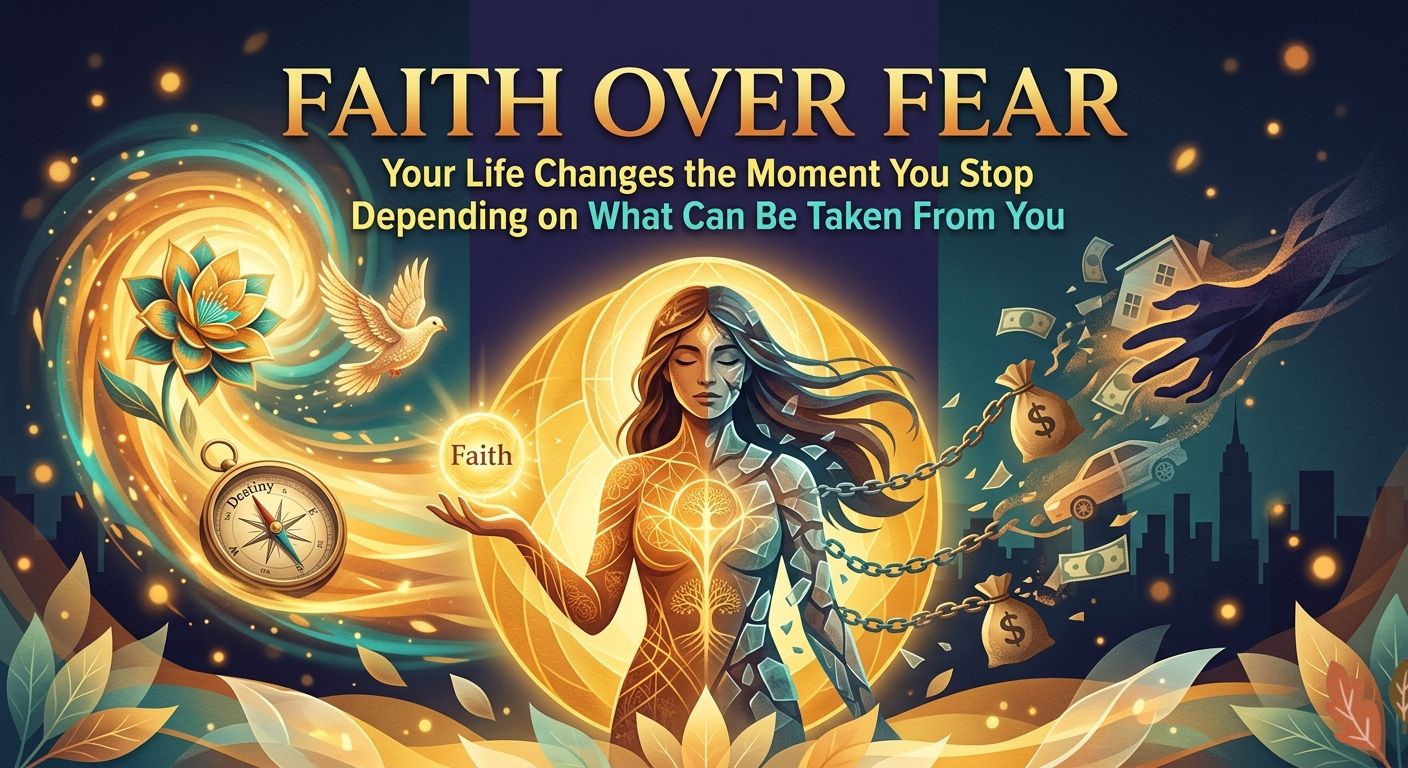
Faith Over Fear becomes possible when God becomes your anchor and circumstances stop being your foundation.
Across spiritual traditions people have drawn strength from the belief that life contains meaning beyond what can be immediately seen. Studies in the psychology of religion have found that individuals with a strong sense of spiritual trust often demonstrate greater resilience during periods of uncertainty because they perceive themselves as supported by a larger purpose rather than isolated within temporary events.
Trusting God when life feels uncertain does not mean having every answer. It means recognizing that your peace does not have to rise and fall with every changing situation. It means understanding that while circumstances remain unpredictable your foundation does not have to be.
What Do These Lessons Reveal About Lasting Faith?
Fear becomes stronger when self trust is weak. Fear becomes stronger when stability depends entirely on external things. Faith becomes stronger when a person develops a foundation that remains steady even when circumstances do not. This is why lasting faith is not blind optimism. It is a deeper form of trust that creates stability where uncertainty once created fear.
5 Practical Steps To Strengthen Faith Over Fear When Life Feels Uncertain
Understanding fear explains the problem. Understanding faith explains the solution. The challenge most people face is turning that understanding into something they can practice on an ordinary Tuesday afternoon when life still feels uncertain.
Research consistently shows that beliefs become stronger through repeated behaviours rather than occasional inspiration. This means faith is not built during rare moments of certainty. It is built through small daily actions that train the mind to respond differently when uncertainty appears.
Step 1: How Can You Separate Fear From Facts?
The first practice is learning to distinguish reality from prediction.
Whenever uncertainty appears pause and ask a simple question.
“Is this happening right now or am I imagining what might happen next?”
This technique closely mirrors cognitive behavioural approaches used in psychology to reduce anxiety because it interrupts automatic fear based thinking. Many fears lose a significant amount of their power once they are examined rather than automatically believed.
Faith grows when reality becomes clearer.
Fear grows when assumptions go unquestioned.
Step 2: How Can You Keep Your Mind Connected To Something Higher?
Trust becomes difficult when attention remains completely absorbed by problems.
One of the recurring themes throughout Christianity is that trust grows through regular connection with God rather than through perfect circumstances. This is why prayer reflection and remembrance remain central practices for many believers during uncertain seasons of life.
Keeping a sacred reminder such as your favourite god’s Idols and pictures in a prayer space can serve as a simple visual anchor throughout the day. The purpose is not decoration. The purpose is redirection. Each moment of remembrance gently shifts attention away from uncertainty and back toward trust.
This is one reason many spiritual practitioners report greater emotional stability during challenging periods. Their attention repeatedly returns to something larger than the problem itself.
Step 3: How Can You Build A Stronger Spiritual Foundation?
Faith becomes more stable when it is reinforced through consistent learning.
Reading even a small section of the Bhagavad Gita or Bibble can provide a daily reminder that uncertainty has always been part of the human experience. These text repeatedly teaches action without attachment to outcomes which directly addresses one of the primary causes of fear. Similarly one of the central messages of the Bible is that God’s presence and faithfulness do not depend on perfect circumstances; His promises remain steady even when life feels uncertain.
Research in the psychology of religion has found that people who engage regularly with meaningful spiritual teachings often demonstrate higher resilience during stressful periods because those teachings provide a framework for interpreting uncertainty.
Knowledge strengthens conviction.
Conviction strengthens faith.
Step 4: How Can Gratitude Reduce Fear About The Future?
Research from psychologists such as Robert Emmons has repeatedly found that gratitude practices improve optimism and psychological wellbeing.
Fear constantly asks:
“What might go wrong?”
Gratitude asks:
“What is already going right?”
One practical habit is ending each day by identifying three specific things that went well.
Not general things.
Specific things.
Over time this trains the mind to notice support rather than only threats.
Faith becomes easier when your attention learns to recognize evidence of guidance and provision already present in your life.
Step 5: How Can You Keep A Record Of God’s Faithfulness?
Research in psychology shows that people naturally remember threats and setbacks more vividly than periods of safety and support. This tendency is known as negativity bias.
One practical way to counter this pattern is to create a written record of moments when life worked out despite uncertainty.
Moments when:
help arrived unexpectedly
a solution appeared
a fear never happened
a difficult period eventually passed
Many people discover that fear becomes less convincing when they have evidence from their own life that they have been guided supported or strengthened before.
Over time this record becomes more than a journal.
It becomes proof.
Faith grows stronger when the mind regularly remembers what fear tends to forget.
CONCLUSION
Faith does not guarantee that life will unfold exactly as we hope, but it can change the quality of our response to life’s uncertainties.
Research suggests that when fear no longer dominates the mind, people often think more clearly, make wiser decisions, and respond more effectively to challenges. Anchoring our trust in God provides a source of stability that circumstances alone cannot offer.
In this way, faith becomes more than a spiritual belief. It becomes a practical foundation for living with greater peace, clarity, resilience, and purpose.