
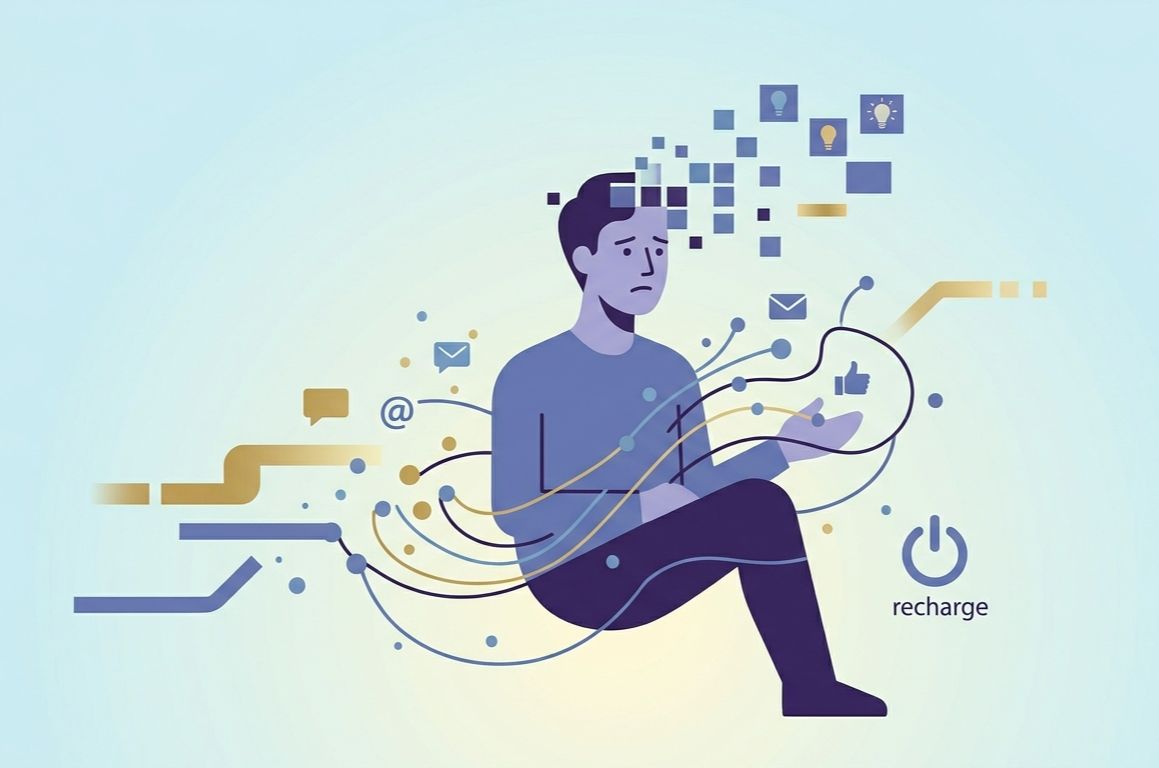
Why Digital Overstimulation Is Making Modern Life Feel Mentally Louder
Digital overstimulation has quietly become one of the defining psychological pressures of modern life. Most people are no longer living in physically dangerous environments, but they are living inside systems that compete for their attention every minute of the day.
The modern brain is repeatedly pulled into rapid attention-switching due to continuous digital inputs such as notifications, feeds, and short-form content in a single day than previous generations experienced across much slower routines. Each switch activates cognitive reorientation processes, which consume mental energy and gradually reduce the brain’s ability to maintain deep focus for extended periods. Over time, the nervous system adapts to high-frequency stimulation, making slower cognitive states feel less natural.
This is why many people today feel mentally tired even after physically resting.
Research in cognitive psychology shows that frequent task-switching and high information exposure are linked to reduced working memory efficiency and increased mental fatigue. Studies on attention regulation also indicate that constant digital interruption reduces the brain’s ability to sustain uninterrupted thought flow.
In real life, this appears as difficulty in staying mentally present, reduced patience for deep tasks, and a persistent feeling of mental overload even in quiet environments. It is not a loss of intelligence, but a shift in how attention is trained under constant stimulation environments.
5 Types of Digital Stimulation Constantly Competing for Attention
The problem is not simply “using phones too much.” The deeper issue is the nonstop layering of stimulation throughout the day.
Modern digital environments continuously pull attention through:
1. Short-Form Entertainment
Fast-moving videos, endless scrolling, meme culture, and algorithm-driven feeds train the brain to expect constant novelty within seconds.
2. Notification-Based Interruption
Messages, app alerts, emails, and social updates repeatedly interrupt concentration before the brain fully settles into deeper focus.
3. Emotionally Charged Content
Outrage headlines, online debates, fear-based news cycles, and comparison-heavy social media content keep the nervous system mentally activated for long periods.
4. Multi-Screen Consumption
Many people now consume multiple streams of stimulation simultaneously, such as watching videos while texting or scrolling social media during work tasks.
5. Infinite Recommendation Systems
Modern platforms rarely allow natural stopping points. Autoplay systems and personalized recommendations are intentionally designed to extend attention for as long as possible.
Individually, these habits may seem harmless.
Collectively, they create environments the human brain was never designed to process continuously.
Why the Human Brain Struggles With Constant Input
For most of human history, attention moved at a slower pace.
People processed life through: direct conversation, physical activity, natural surroundings, manual work, and quieter transitions between tasks.
The brain had recovery space.
Modern digital life has reduced much of that mental recovery time. Instead of pauses, the brain now experiences constant switching between stimulation sources.
And attention switching is mentally expensive.
Even brief interruptions force the brain to repeatedly reorient itself. Over time, this increases cognitive fatigue and weakens sustained focus capacity.
This is one reason many people now struggle to: read deeply, work without distraction, or stay mentally present for long periods.
What Dopamine Actually Does in the Brain
Dopamine is one of the most misunderstood psychological terms on the internet today.
It is not simply a “happiness chemical.”
Neuroscientists more accurately describe dopamine as part of the brain’s motivation and reward system. In simple terms, dopamine helps push human beings toward effort, pursuit, achievement, and anticipation.
Historically, reward usually followed effort.
People worked, practiced, built, explored, solved problems, or created something meaningful before receiving satisfaction from the result.
Modern digital platforms compress that process dramatically.
Today, the brain can receive stimulation, novelty, validation, entertainment, and anticipation instantly through a screen. The reward signal arrives quickly, often before any meaningful effort happens.
Over time, this changes behaviour patterns in subtle ways.
3 Ways Instant Digital Rewards Are Affecting Motivation
1. Difficult Tasks Begin Feeling Mentally Heavier
The brain gradually becomes more attracted to fast stimulation than slower long-term rewards.
2. Focus Endurance Starts Weakening
Activities requiring sustained concentration begin competing against environments designed for rapid novelty.
3. Silence Starts Feeling Uncomfortable
When the brain becomes accustomed to constant stimulation, quieter moments can begin feeling unusually empty or restless.
This is why many people now instinctively reach for their phones during even the smallest pauses in daily life.
Not because they consciously choose distraction every time, but because modern platforms are increasingly shaping attention habits beneath awareness itself.
How Digital Overstimulation Is Reshaping Attention Span and Daily Thinking
One of the biggest effects of digital overstimulation is not always obvious immediately. Most people do not suddenly lose focus overnight. The shift usually happens gradually through repeated exposure to fast-moving digital environments that train the brain to expect constant stimulation.
Over time, this changes how people consume information, complete tasks, handle boredom, and even participate in conversations.
A growing number of neuroscientists and behavioral researchers now believe modern attention patterns are being heavily influenced by what many experts call the “attention economy,” where digital platforms compete aggressively to keep users engaged for longer periods.
And the longer this exposure continues, the more daily thinking patterns begin adapting around speed rather than depth.
4 Attention Habits Modern Digital Platforms Are Quietly Training
Digital platforms are not only influencing what people consume. They are influencing how people think.
1. Faster Content Scanning
Many users now skim information rapidly instead of processing it deeply. Headlines, captions, thumbnails, short clips, and swipe-based content encourage constant movement rather than sustained attention.
This is one reason long-form reading has become mentally harder for many people despite higher overall content consumption.
2. Reduced Patience for Slower Activities
Activities without instant stimulation now compete against platforms engineered for immediate engagement.
Reading books, learning complex skills, deep conversations, creative work, and long-focus tasks
often feel mentally “slower” by comparison, even when they are more meaningful long term.
3. Constant Context Switching
Modern attention rarely stays in one place for long.
A person may: reply to messages, watch videos, check notifications, switch tabs, and scroll social media
within the same few minutes.
Research from institutions like has repeatedly explored how heavy multitasking behavior can reduce concentration quality and increase cognitive overload over time.
4. Dependency on External Stimulation
Many people now struggle to remain mentally engaged without background stimulation running continuously.
Silence, single-task focus, or slower-paced environments
can begin feeling unusually restless because the brain becomes accustomed to high-input environments.
3 Everyday Signs Attention Fatigue Is Becoming More Common
1. People Reach for Their Phones During Small Pauses
Elevators, waiting rooms, short queues, and even brief moments of silence now trigger automatic screen-checking behaviour for many individuals.
2. Entertainment Consumption Keeps Increasing While Satisfaction Drops
Many people consume hours of content daily yet still describe feeling mentally scattered afterward rather than refreshed.
3. Conversations Are Becoming More Fragmented
Interruptions, divided attention, and second-screen habits increasingly affect face-to-face communication quality.
This shift is subtle, but socially significant.
Why This Matters Beyond Productivity
The effects of digital overstimulation are not limited to work efficiency or screen habits alone.
Attention shapes: decision-making, learning quality, memory formation, conversation depth, creativity, and self-awareness.
In many ways, attention determines how fully people experience life itself.
And when attention becomes constantly fragmented, even meaningful experiences can begin feeling mentally rushed.
Why Constant Stimulation Is Affecting Memory, Relationships, and Inner Awareness
One of the most overlooked effects of digital overstimulation is that it does not only affect attention span. Over time, it also changes how people absorb information, process experiences, remember conversations, and connect emotionally with the world around them.
The modern brain is consuming more information than ever before, but much of that information is being processed too quickly to settle deeply.
People are often reading, watching, scrolling, replying, switching, and reacting
at such a rapid pace that the brain receives input without fully consolidating it.
And neuroscience increasingly shows that attention quality directly affects memory quality.
Why Fast Consumption Weakens Deep Learning
The brain does not store information effectively when attention remains fragmented.
Researchers studying cognitive processing have repeatedly found that memory formation becomes weaker when information is consumed through constant interruption or divided attention. The brain needs moments of focus and mental pause to properly organize what is important, what should be remembered, and what can be discarded.
Without that filtering process, information often stays shallow.
This is one reason many people now experience a strange contradiction: they consume enormous amounts of content daily, yet retain very little of it long term.
The issue is not lack of intelligence.
The issue is that modern digital behaviour often prioritises rapid exposure over deep processing.
4. Areas of Life Where Reduced Attention Is Quietly Creating Problems
1. Important Conversations Are Being Half-Processed
In many relationships today, people are physically present but mentally divided.
Someone may be listening while simultaneously: checking notifications, thinking about another task, or unconsciously craving stimulation.
Over time, this weakens communication quality.
Important emotional concerns, relationship boundaries, professional guidance, or meaningful conversations
can lose depth when attention becomes fragmented.
And in relationships, feeling unheard repeatedly creates distance faster than many people realize.
2. Creativity Is Being Replaced by Continuous Consumption
The brain needs mental space to reflect, imagine, and connect ideas creatively.
But constant stimulation leaves very little room for internal processing.
Historically, many breakthroughs in philosophy, architecture, science, spirituality, literature, and invention emerged during slower states of observation and sustained concentration. Today, many people spend far more time consuming creativity than developing it.
Over time, this weakens one of the brain’s most important abilities: the capacity to sit with an idea long enough to transform it into something original, meaningful, and deeply understood.
3. Inner Awareness Starts Becoming Weaker in Overstimulated Environment
In several Vedic, Buddhist, and yogic philosophies, the idea of divinity was not always described as something completely separate from human consciousness.
Instead, many teachings suggested that beneath constant mental distraction exists a deeper state of awareness connected to something universal, eternal, and beyond temporary identity.
But according to these traditions, that awareness becomes difficult to recognize when the mind remains continuously agitated.
A distracted mind focuses outward constantly. A still mind begins observing inwardly.
And historically, meditation created conditions where people could temporarily step away from: social conditioning, daily stimulation, ego-driven thinking, and emotional turbulence
long enough to experience a quieter state of perception.
This is one reason many ancient spiritual systems valued: silence, solitude, disciplined attention, and mindful observation so deeply.
Not because silence itself was magical, but because clarity becomes easier when mental noise reduces.
Why This Idea Feels More Relevant in Modern Life
Modern digital life keeps attention externally engaged almost continuously.
Notifications, content feeds, constant information, comparison culture, and rapid stimulation
leave very little uninterrupted space for self-observation.
This is partly why many people today feel mentally crowded even when physically alone.
The mind rarely gets enough stillness to process experience deeply.
And whether someone approaches meditation spiritually, psychologically, or scientifically, one principle remains consistent across traditions:
A mind that never slows down struggles to observe itself clearly.
4. How Reduced Attention Span Quietly Affects Career Growth and Relationships
One of the biggest hidden consequences of digital overstimulation is that fragmented attention eventually affects real-world communication quality.
And this impact is often subtle at first.
A manager explains an important strategy during a meeting. A colleague shares critical feedback. A partner expresses an emotional concern. A family member tries to communicate something meaningful.
But if the brain has become conditioned to rapid attention switching, many people only process these moments partially.
Not intentionally.
But because their attention is divided internally.
This creates practical consequences that go far beyond screen habits.
Professionally, reduced attention can affect: decision-making quality, instruction retention, deep learning, problem-solving, and communication accuracy.
This is partly why many experts now argue that the modern attention crisis is not only a productivity issue. It is increasingly becoming a relationship issue, a learning issue, and a quality-of-life issue.
Studies on multitasking behavior continue to show that constant task-switching increases cognitive strain and reduces sustained concentration performance over time.
How to Reduce Digital Overstimulation Without Escaping Modern Life
Digital overstimulation is not solved by completely rejecting technology. Modern life depends on digital tools for work, communication, learning, and daily convenience. The real goal is not elimination. It is rebuilding healthier attention patterns before constant stimulation becomes the brain’s default setting.
And small behavioural changes matter more than extreme “digital detox” trends that most people abandon after a few days.
Research from cognitive psychologist Gloria Mark and workplace attention studies has found that average sustained screen attention has dropped dramatically over the past two decades, with many workers now switching tasks or screens in under a minute during digital work environments.
That matters because attention patterns strengthen through repetition.
4 Practical Ways to Reduce Mental Overload in Daily Life
1. Create Small Periods of Single-Task Focus
The brain performs better when attention stays in one place long enough to process information properly.
Instead of constantly switching between: messages, videos, emails, notifications, and multitasking,
train the brain to complete one mentally demanding activity at a time for short uninterrupted periods.
Even 20 to 30 minutes of focused attention daily can gradually improve concentration endurance over time.
2. Reduce Unnecessary Stimulation During Routine Activities
Many people now consume stimulation continuously from morning until sleep.
But the brain needs low-input moments to mentally reset.
Simple changes help more than people expect: walking without constant audio, eating without scrolling, or allowing short periods of silence between tasks.
These moments give the nervous system recovery space that constant stimulation removes.
3. Protect the First and Last Hour of the Day
One of the fastest ways to reduce digital overstimulation is limiting intense screen exposure immediately after waking up and before sleeping.
Morning overstimulation floods the brain with external input before mental focus stabilises. Nighttime overstimulation keeps attention mentally activated when the brain should be slowing down.
This is partly why many sleep researchers now recommend reducing fast-moving digital content before bed whenever possible.
4. Replace Passive Consumption With Deeper Engagement
The goal is not simply reducing screen time. It is changing the quality of attention.
Activities such as: long-form reading, creative work, journaling, learning difficult skills, mindful exercise, meditation, or deeper conversations
train the brain differently than rapid-content consumption.
They strengthen patience, reflection, memory formation, and sustained thinking capacity over time.
And psychologically, this matters because the brain gradually adapts to whatever environment it experiences repeatedly.
Why Recovery Starts With Attention Awareness
Many people try to improve focus while continuing the exact habits that fragment attention all day.
But attention is trainable.
The brain adapts continuously to: speed, stimulation, distraction, or stillness.
And in a culture built around constant interruption, protecting mental space is no longer only a productivity habit.
It is becoming a cognitive health habit.
Rebuilding Mental Clarity Through Attention-Friendly Environments
Modern cognitive recovery does not depend on specific branded products but on creating environments that support sustained attention and reduced sensory overload. Research in behavioral psychology shows that attention is strongly shaped by external cues, meaning small environmental adjustments can significantly improve mental clarity over time.
When the brain is exposed to fewer stimulation triggers, dopamine-driven reward cycles stabilize, allowing improved focus endurance and reduced compulsive checking behavior. Lower sensory input also supports parasympathetic nervous system activation, which helps the brain shift from alert-reactive mode to calm-reflective mode.
Studies in environmental psychology and neuroscience suggest that reducing constant digital triggers improves working memory performance and reduces cognitive fatigue over time. Research also highlights that structured attention environments improve long-term focus consistency.
In practical life, this means designing daily routines that reduce unnecessary stimulation, supporting longer focus periods, and allowing the mind to recover naturally. Simple environmental shifts such as reducing notifications, practicing single-task focus, and incorporating quiet intervals help restore mental clarity without requiring lifestyle isolation or extreme digital avoidance.
Why Mental Clarity Is Becoming a Modern Luxury
In earlier generations, moments of silence happened naturally.
Today, silence often has to be created intentionally.
And that shift matters psychologically.
Modern culture rewards: speed, reaction, constant availability, and nonstop stimulation.
But the human nervous system still depends on: rest, reflection, focus, and recovery.
This is why mental clarity increasingly feels rare today. Not because people are weak, unintelligent, or unmotivated, but because uninterrupted attention has become one of the most interrupted resources in modern life.
And protecting it is no longer only about productivity.
It is increasingly becoming part of protecting long-term cognitive, emotional, and psychological well-being itself.
Conclusion
Digital overstimulation is not a minor modern inconvenience anymore. It is reshaping how people think, focus, communicate, remember, rest, and experience everyday life.
The solution is not abandoning technology completely. It is learning how to use technology without allowing constant stimulation to dominate attention continuously.
Because attention shapes far more than productivity alone.
It shapes: memory, relationships, creativity, self-awareness, decision-making, and the overall quality of human experience.
And in a world constantly competing for attention, the ability to protect mental space may quietly become one of the most valuable skills of modern life.