Why Choosing Peace Feels Harder Than Continuing Familiar Struggle
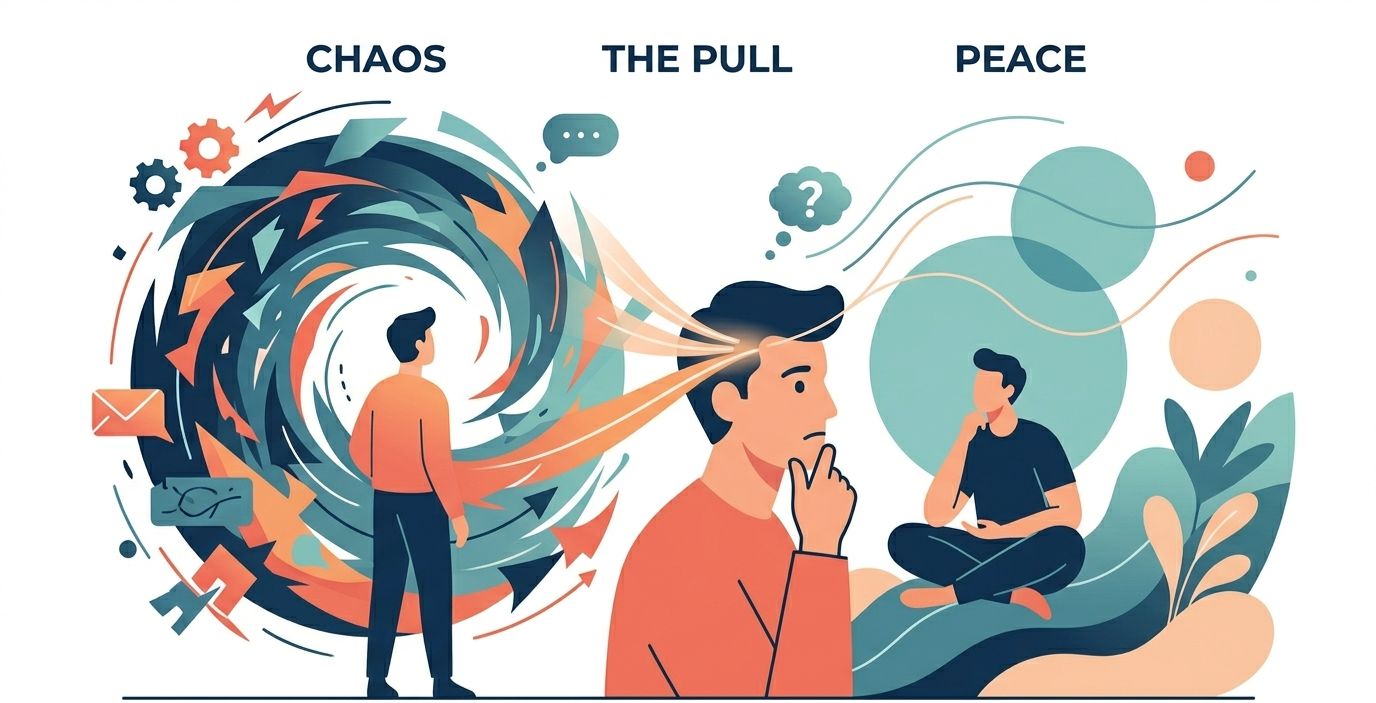
Many people do not consciously choose chaos over peace. They gradually adapt to stressful environments, demanding routines, and emotionally exhausting patterns until those experiences begin to feel normal.
What often keeps people stuck is not a lack of desire for a calmer life, but a reduced awareness that a different way of living is possible.
Over time, familiar struggle can start feeling more realistic, predictable, and acceptable than unfamiliar peace.
The human brain is designed to adapt to repeated experiences in order to conserve energy and maintain stability.
When stress, pressure, conflict, or constant busyness become part of everyday life, the mind slowly treats these conditions as expected rather than exceptional.
As repeated patterns become familiar, people stop evaluating whether those patterns still support their well-being. Temporary coping strategies gradually become automatic ways of living.
Psychological research on habituation and behavioural adaptation shows that repeated exposure changes how people perceive their environments over time.
Researchers have found that individuals often normalize ongoing stressors when those conditions remain consistent, even when they negatively affect emotional well-being, relationships, and quality of life.
Studies on chronic stress also suggest that prolonged exposure to demanding environments can reduce awareness of healthier alternatives by making high-pressure living feel routine.
This is why many people continue lifestyles that leave them mentally drained, emotionally overwhelmed, or disconnected from themselves without immediately questioning those patterns.
The challenge is not always choosing chaos intentionally.
Sometimes the real challenge is recognizing that what feels familiar is not always what feels peaceful.
Three Signs a Person Has Started Normalising Chaos
1. Daily Exhaustion Starts Feeling “Normal”
One of the clearest signs appears when constant tiredness becomes accepted as an ordinary part of life rather than a signal that something needs attention.
Many people wake up mentally heavy, move through routines that continuously drain them, and remain surrounded by environments that never allow genuine rest. Instead of questioning these patterns, they slowly begin believing adulthood itself is supposed to feel permanently exhausting.
Recent workplace and mental health studies have repeatedly shown rising global burnout levels, particularly among younger adults managing financial pressure, emotional stress, and nonstop life demands. Yet despite this, many individuals continue treating exhaustion as proof of responsibility rather than a warning sign of imbalance.
2. Rest Begins Creating Guilt Instead of Relief
Modern culture often glorifies struggle in ways people do not immediately notice.
Constant productivity, emotional endurance, and nonstop pressure are frequently treated as symbols of discipline or importance. Slowly, this conditions people to feel uncomfortable with slowing down.
Instead of rest creating restoration, it begins creating guilt.
This is one of the deeper psychological patterns behind why many individuals continue choosing pressure-filled lifestyles even when their mind and body are clearly asking for change.
In Hindu philosophy, Kaliyug is often described as an age of distraction, conflict, and declining inner awareness. Psychologically, the deeper danger is not only the presence of chaos, but how repeated exposure slowly conditions people to accept stress, imbalance, and disconnection as normal life.
3. Familiar Pain Starts Feeling Safer Than Change
Behavioral psychology consistently shows that familiarity strongly influences decision-making. Human beings often stay connected to patterns they already understand, even when those patterns repeatedly hurt them.
This can appear in many forms:
remaining inside emotionally draining relationships,
continuing unhealthy routines,
tolerating environments that disturb inner calmness,
or waiting for life to change while repeating the same choices daily.
Not because people consciously want suffering, but because unfamiliar peace can initially feel uncertain.
That is why many individuals are not completely trapped by life itself. They are trapped by conditioning that slowly convinced them they no longer have meaningful choices available.
When People Finally Realise They Do Not Have to Live in Survival Mode
One of the most important shifts begins when a person stops treating suffering as a permanent identity.
Real change often begins when someone recognizes they are allowed to want a calmer and healthier life without guilt.
Research in behavioral change psychology repeatedly shows that awareness is often the first stage of transformation. People rarely change patterns they have not consciously recognized yet.
This is why the power of choice feels invisible for so many people at first. Not because choice disappeared, but because prolonged stress, conditioning, and survival-based living slowly disconnected them from the belief that another way of living could belong to them too.
And sometimes the beginning of choosing peace is not a dramatic life change.
Sometimes it begins with the simple realization that peace was never reserved for other people alone.
4 Ways The Power of Choice Begins When You Stop Worshipping Survival Mode
1. External Freedom Does Not Always Mean Inner Freedom
Many people are physically free, yet internally controlled by survival patterns they no longer consciously recognize.
They continue tolerating environments, relationships, and routines that quietly damage their inner stability because those patterns have become psychologically familiar over time.
According to the American Psychological Association, prolonged stress exposure can significantly affect emotional regulation, behavioral response patterns, and long-term decision-making. Eventually, survival mode stops feeling temporary and starts shaping identity itself.
This is why choosing peace feels difficult for many people even when suffering becomes visible.
Not because people lack choices, but because survival conditioning slowly begins controlling decision-making from the background.
2. Awareness Changes Lives More Than People Realise
People often define freedom as the ability to do whatever they want.
But real freedom is being able to choose peace over patterns that continuously destroy inner stability.
That is emotional maturity. That is spiritual evolution.
This is why self-awareness often becomes the beginning of long-term behavioral change.
Unconscious patterns repeat automatically. Conscious awareness interrupts them.
The moment people clearly recognize what is draining their psychological balance, nervous system regulation, mental clarity, internal alignment or spiritual well-being, the power of choice slowly starts returning back into their hands.
3. Your Inner Wisdom Is Evidence of Your Capacity to Grow Beyond Limitation
Human beings are not designed to survive only through instinct.
We are given awareness, discernment, consciousness, and the ability to choose differently. That itself reflects divine nature.
Because if human beings were truly powerless, growth would never be possible. Nobody would ever be able to leave what continuously destroys their peace.
Many modern studies on behavioral change support a similar principle: transformation usually begins when people consciously recognize the patterns they previously normalized.
Awareness is often the first interruption before change becomes action.
4. When Emotional Resistance Becomes an Invitation to Realign Your Life
Long before people consciously accept the truth, the mind and body often recognize misalignment first.
That silent exhaustion people feel inside toxic environments and chaotic lifestyles is not always weakness or oversensitivity.
Sometimes it is the internal warning system signaling that a pattern is no longer sustainable.
According to the World Health Organization, stress-related mental and physical health concerns have continued rising globally, particularly among adults living under constant psychological pressure and instability.
In psychology, this internal conflict is often associated with emotional dissonance, where a person’s inner reality no longer aligns with the life they continue tolerating externally.
Spiritually, many people experience this as the soul resisting what no longer aligns with their true nature.
And often, that realisation becomes the beginning of change.
Why Calmness Can Feel Uncomfortable After Years of Stress
Many people say they want peace, but the moment life becomes quieter, they suddenly feel restless.
Not because something is wrong. Because the nervous system has spent years adapting to pressure.
When the brain becomes used to constant stimulation, unpredictability, or emotional tension, calmness can initially feel unfamiliar instead of comforting. Behavioral researchers have long observed that human beings adapt psychologically to repeated environments, even unhealthy ones. Over time, chaos stops feeling abnormal simply because it became familiar.
This is why some people unconsciously create noise around themselves the moment life finally becomes stable.
Not every uncomfortable feeling is a warning sign.
Sometimes it is simply the mind adjusting to a healthier reality.
3 Small Signs You Are Finally Leaving Survival Mode Behind
The shift toward peace rarely looks dramatic at first.
In real life, it often begins through smaller changes people almost overlook.
1. Silence Stops Feeling Threatening
You no longer need constant distraction to avoid your own thoughts.
A quiet evening starts feeling restful instead of emotionally heavy.
2. Rest Stops Feeling Like Laziness
People living in survival mode often feel guilty while slowing down.
As inner balance returns, rest starts feeling restorative instead of irresponsible.
3. You Stop Chasing Intensity to Feel Alive
One of the clearest psychological shifts happens when chaos no longer feels exciting.
You begin valuing consistency more than emotional unpredictability.
And honestly, this is where many people finally realise: peace is not boring. It is stability without constant internal exhaustion.
How Emotionally Safe Environments Quietly Change a Person
Human beings change inside environments that no longer force them to stay emotionally guarded all the time.
That change is often subtle before it becomes visible.
People usually notice it through ordinary moments: sleep improves, the body feels lighter, conversations feel less draining, and the mind slowly regains clarity again.
Research from the American Psychological Association has repeatedly linked long-term stress exposure with mental fatigue, emotional dysregulation, and difficulty concentrating. But researchers also consistently observe that supportive environments can gradually improve resilience, emotional regulation, and overall well-being over time.
This is why peaceful environments matter more than people think.
Not because life suddenly becomes perfect.
But because the body finally stops preparing for danger every second of the day.
4 Small Habits That Quietly Make Life Feel More Peaceful
A calmer life is rarely created through one dramatic decision.
Behavioral psychology research consistently shows that daily routines and repeated environmental patterns shape long-term mental stability far more than temporary motivation.
1. Spending Less Time Around Constant Negativity
Many people underestimate how strongly constant negativity affects the nervous system.
Reducing exposure to draining conversations, unnecessary conflict, and overstimulating content often creates noticeable mental clarity within weeks.
2. Creating an Environment That Feels Safer to Live In
Small changes inside personal spaces can genuinely influence emotional stability.
Sleep researchers and environmental psychologists have repeatedly found that lighting, noise levels, room organisation, and calming sensory environments affect stress recovery and daily focus.
3. Stopping the Habit of Treating Exhaustion Like Success
Modern culture often praises burnout as ambition.
But long-term stress slowly disconnects people from joy, creativity, patience, and healthy decision-making. Choosing proper rest is not weakness. It is nervous system recovery.
4. Repeating Smaller Peaceful Decisions Every Day
A healthier life usually begins quietly.
One better boundary. One healthier routine. One calmer reaction. One honest decision repeated consistently over time can completely change the direction of a person’s future.
The power of choosing peace has always been in your hands.
And the more consciously you protect that power the more your life slowly begins transforming into something lighter, clearer, happier, and deeply worth living.
Lifestyle Changes More People Are Making to Feel Mentally Calmer Again
Why “Nervous System Recovery” Has Become a Major Wellness Trend
Mental exhaustion is no longer discussed only inside therapy spaces. It has become part of everyday modern life.
This is one reason wellness researchers are seeing rising interest in products designed around better sleep quality, reduced overstimulation, calmer environments, and healthier daily rhythms.
Instead of extreme self-improvement routines, many people are now investing in quieter lifestyle support systems that help the mind slow down naturally.
4 Modern Lifestyle Tools That Can Support a Calmer Daily Routine
1. Sleep-Recovery Products
Sleep specialists consistently link poor sleep with higher stress levels and reduced emotional regulation.
This is why products like sunrise alarm clocks, weighted sleep masks, and warm nighttime lighting have become increasingly popular among people trying to create healthier evening routines.
2. Low-Stimulation Environment Design
Environmental psychology research shows that noise-heavy and visually cluttered spaces can increase mental fatigue over time.
Many people now intentionally create quieter spaces through: soft lighting, minimalist room layouts, noise-reduction tools, and screen-free corners designed for reading, prayer, or reflection.
3. Guided Relaxation and Breathing Devices
Breathing-based relaxation tools, calming audio devices, and meditation-focused wellness gadgets are becoming more common because they help people create moments of mental stillness inside fast-paced routines.
Even a few minutes of slower breathing daily has been associated with lower stress activation in multiple behavioural health studies.
4. Intentional Offline Rituals
One of the strongest modern wellness shifts is the return toward slower offline habits.
Simple routines like journaling, herbal evening tea, devotional music, analog planning, or screen-free mornings are helping many people feel mentally clearer without needing constant stimulation all day.
Conclusion
A peaceful life is not a fantasy reserved for other people.
It can slowly become your reality the moment you begin choosing yourself with more awareness and courage each day.
The more consciously you protect your inner calm the more your life starts filling with better energy, healthier connections, clearer thinking, genuine happiness, and moments that finally feel worth waking up for.
And one day you may look around and realise the life you once prayed for quietly began growing the moment you stopped choosing chaos.