
Why Does Emotional Attachment Feel So Painful Today? 4 Psychological Shifts That Explain It
Why is attachment so painful for so many people today even when they still have the relationship, the career, the family, or the life they once prayed for?
This question is becoming more common because modern emotional exhaustion is no longer caused only by visible loss. Many people are now feeling mentally drained while still holding on to the very things they fear losing. That quiet fear changes the way people think, sleep, communicate, and experience daily life.
A 2023 report published by the American Psychological Association found that long-term emotional stress and uncertainty can slowly increase hyper-vigilance within the nervous system. Over time the brain starts treating emotional security like a survival need instead of a healthy human experience. This is where attachment often stops feeling comforting and starts feeling heavy.
Most people do not notice when emotional connection slowly turns into emotional dependence. The shift happens quietly. Someone starts checking messages more often. Silence begins to feel threatening. Small changes in behaviour feel emotionally dangerous. Peace becomes dependent on reassurance.
This is one of the biggest reasons attachment hurts so deeply. The mind starts building stability around things that were never fully within human control.
1. Why Modern Life Is Making Emotional Attachment Stronger
Modern life constantly trains the brain to seek emotional reinforcement.
Social media notifications create reward anticipation. Instant communication reduces emotional space. Validation becomes measurable through replies, reactions, and attention. Even relationships now operate inside an environment of constant accessibility.
Neuroscience researchers at Stanford University have repeatedly discussed how unpredictable rewards strengthen compulsive attention patterns inside the brain. The same psychological mechanism behind repeated phone checking can also intensify emotional fixation in relationships. Uncertainty increases mental attachment because the brain keeps searching for reassurance.
This is why many people today are not only emotionally attached to people. They are attached to responses, attention, consistency, availability, and emotional predictability.
The deeper problem is that human life itself is unpredictable. Relationships shift, circumstances change, emotions fluctuate, and new life stages reshape priorities. The challenge is not change itself, but the attached mind’s difficulty accepting that change is inevitable.
But the emotionally attached mind struggles to accept change naturally. It keeps searching for permanence inside temporary experiences.
2. When Emotional Attachment Starts Affecting Identity
Attachment becomes far more painful when identity gets involved.
Many people are no longer only afraid of losing someone. They are afraid of losing the version of themselves that exists around that person or situation.
A relationship may become their emotional stability.
A career may become their self-worth.
A social identity may become their entire sense of value.
When identity becomes emotionally fused with something external the nervous system starts reacting to uncertainty as if the self itself is under threat.
Psychologists often describe this as emotional over-identification. It happens when personal worth becomes excessively tied to external outcomes or relationships. Research from the University of Exeter has linked unhealthy attachment patterns with higher emotional instability, anxiety sensitivity, and reduced emotional regulation during periods of uncertainty.
This explains why attachment can feel physically painful instead of only emotionally uncomfortable.
The body reacts too.
Sleep changes.
Appetite changes.
Focus weakens.
Mental clarity drops.
Emotional reactions become sharper.
The suffering is no longer only about love or loss. It becomes a full psychological state.
3. What Ancient Spiritual Traditions Understood About Attachment Long Before Modern Psychology
Long before neuroscience began studying emotional dependence many spiritual traditions had already identified attachment as a major source of human suffering.
In the attachment is repeatedly described as something that clouds discernment and disturbs inner stability. One of the central ideas within Vedantic philosophy is that suffering increases when human beings try to emotionally control outcomes that constantly change by nature.
Buddhist teachings also describe attachment as a root cause of suffering not because love is wrong but because clinging creates fear. The fear of losing. The fear of change. The fear of uncertainty.
What makes these teachings still relevant today is that modern psychology is now observing many of the same patterns through clinical research.
Emotional dependence often develops gradually through repeated reassurance-seeking behaviours. Over time, silence begins to feel threatening, small behavioural changes feel significant, and emotional stability becomes increasingly dependent on external validation.
This does not mean human connection is unhealthy. It means emotional dependence becomes dangerous when inner peace disappears every time external circumstances shift.
Why So Many People Secretly Feel Tired of Their Own Emotions
One of the quietest forms of suffering today is emotional exhaustion created by constant internal attachment.
Many people are not physically overworked.
They are emotionally overloaded.
Many people remain mentally exhausted because their attention is constantly occupied by overthinking, anticipating future problems, replaying conversations, and searching for reassurance about situations they cannot fully control.
Over time this creates deep mental fatigue.
This is why detachment is often misunderstood.
Healthy detachment does not mean becoming cold emotionally. It means learning how to experience love, connection, ambition, and relationships without making them responsible for your entire inner stability. That difference changes everything.
How Does Emotional Attachment Change Human Behaviour? 5 Patterns That Quietly Affect Thoughts, Decisions, and Relationships
Most people do not notice when attachment stops being an emotion and starts becoming a behavioural pattern.
At first it feels personal.
Then it slowly begins shaping attention.
• Decisions.
• Reactions.
• Communication.
• Even self-respect.
This is why attachment becomes dangerous long before people realize how deeply it is affecting their life. The real damage often happens quietly through repeated behavioural changes that feel normal in the moment but exhausting over time.
Researchers from University College London have studied how emotionally threatening uncertainty changes cognitive behaviour under stress. Their findings showed that emotionally activated uncertainty can reduce rational processing and increase reactive decision-making. In simple terms the emotionally attached mind often reacts first and reflects later.
That shift changes human behaviour more than most people realise.
1. Why Emotionally Attached People Start Losing Mental Clarity
One of the earliest effects of unhealthy attachment is narrowed mental focus.
The brain starts prioritizing one emotional source above everything else. Over time attention becomes heavily concentrated around one person one fear one outcome or one emotional need.
Over time, attachment narrows a person’s willingness to explore, think expansively, and engage fully with the present moment.
The mind keeps returning to the same emotional center repeatedly.
Modern neuroscience calls this attentional fixation. The brain begins treating emotionally charged stimuli as high-priority survival information. This increases rumination and repetitive thinking patterns inside the prefrontal cortex and limbic system.
That is why emotionally attached people often feel mentally tired even during physically calm periods.
Their nervous system never fully disengages.
2. How Attachment Slowly Creates Control Behaviour
Many people believe control always looks aggressive.
In reality emotional control often appears in socially acceptable forms first.
Emotional control often appears through subtle behaviours such as excessive reassurance-seeking, constant monitoring of emotional responses, overchecking, and heightened sensitivity to perceived distance.
These behaviours usually do not begin from cruelty. They begin from fear.
When emotional stability becomes dependent on another person or situation the mind starts trying to reduce uncertainty through control patterns. This is one reason why attachment can quietly damage relationships while convincing the person they are only “caring deeply.”
Research published in the Journal of Social and Personal Relationships has repeatedly linked anxious attachment patterns with higher emotional monitoring behaviours and increased fear-based communication habits.
The attached mind starts searching for certainty in places where certainty cannot fully exist.
3.Why Attachment Often Distorts Human Perception
Strong emotional fixation changes perception itself.
People stop seeing situations clearly.
They start seeing situations emotionally.
A delayed reply may feel like rejection.
A disagreement may feel like abandonment.
Distance may feel like loss.
The emotional brain begins interpreting neutral experiences through fear-conditioned meaning.
This is one reason attachment becomes spiritually and psychologically exhausting at the same time. The mind is no longer responding only to reality. It is responding to imagined emotional threat.
Ancient yogic psychology described this state as mental bondage created through identification and fear-based attachment. Modern cognitive psychology now studies similar patterns through emotional conditioning and cognitive distortion research.
Different language.
Very similar observation.
The more emotionally attached the mind becomes the harder it becomes to observe situations calmly.
4. Why People Stay Attached Even When They Know It Is Hurting Them
One of the most confusing parts of attachment is this:
people often recognize the suffering yet still struggle to let go.
This happens because attachment is rarely connected only to love.
It becomes connected to:
identity
routine
familiarity
emotional prediction
and psychological comfort.
The human brain prefers familiar pain over unfamiliar uncertainty. Researchers from Harvard Medical School have discussed how predictable emotional patterns can become neurologically reinforcing even when they create distress.
This explains why some people remain emotionally stuck inside relationships situations or emotional cycles they already know are unhealthy.
The attachment itself starts feeling safer than the unknown beyond it.
What Healthy Detachment Actually Changes Inside a Person
Healthy detachment does not remove emotion.
It removes emotional captivity.
A detached person can still love deeply. But their entire inner stability no longer collapses every time life changes unexpectedly.
This is the real difference between connection and attachment.
Connection allows experience.
Attachment demands control.
And the moment a person begins understanding that difference clearly their relationship with suffering also begins changing.
What Is the Hidden Cost of Emotional Attachment? 5 Ways It Can Limit Freedom, Presence, and Life Satisfaction
Many people do not fully recognize the cost of attachment while they are living inside it.
At first it feels meaningful.
Necessary.
Emotionally important.
But years later the same attachment often leaves behind a very different question:
“What did this fear stop me from experiencing?”
This is where attachment begins moving beyond emotional pain and enters something deeper. A growing realization that large parts of life were emotionally postponed while the mind remained trapped in fear uncertainty or emotional fixation.
Researchers in existential psychology have long studied how chronic emotional preoccupation can reduce life engagement and long-term fulfillment. Studies connected to regret theory and emotional avoidance repeatedly show that people tend to experience deeper regret over unlived experiences than temporary discomfort itself.
That pattern appears strongly in unhealthy attachment.
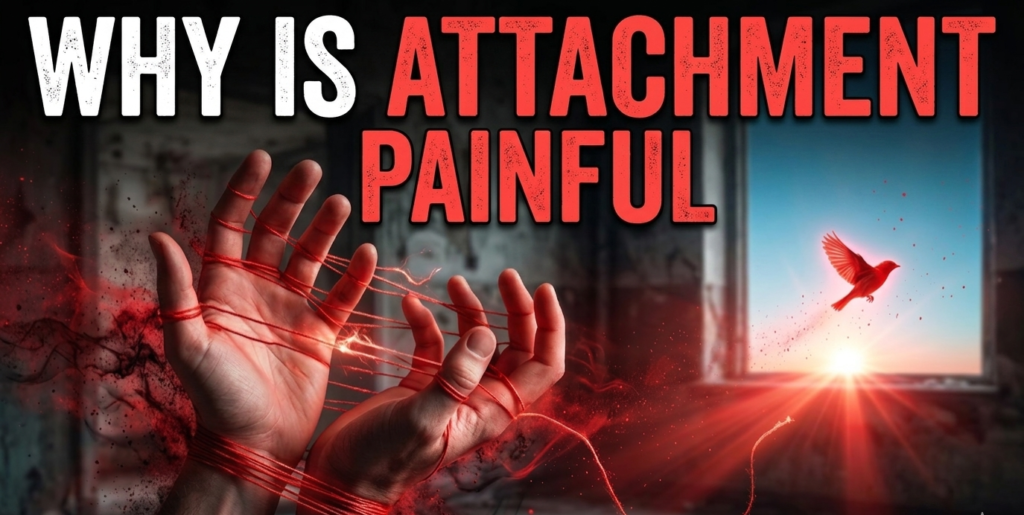
How Attachment Quietly Shrinks Human Experience
One of the least discussed consequences of emotional attachment is how gradually it narrows a person’s relationship with life itself.
People stop exploring freely.
They stop thinking expansively.
They stop engaging fully with the present moment.
Their emotional energy becomes concentrated around preserving one emotional source one relationship one fear or one imagined future outcome.
Over time this creates a form of psychological contraction.
Life becomes smaller emotionally even if nothing changes physically.
A person may still go to work.
Still socialize.
Still function normally.
But internally much of their mental world remains occupied by anticipation emotional monitoring or fear of disruption.
This is one reason why attachment can eventually create emotional emptiness even when life externally appears stable.
2. The Difference Between Living Life and Emotionally Waiting Through It
Many people believe suffering comes only from loss.
In reality suffering also comes from delayed living.
This happens when people unconsciously postpone peace joy creativity self-growth or spiritual connection until one emotional situation finally feels secure enough.
Many people unknowingly postpone peace, believing they will finally relax once relationships improve, uncertainty disappears, or emotional security feels guaranteed.
Psychologists sometimes describe this as contingent happiness. A mental state where emotional well-being becomes dependent on external conditions remaining favorable. Research from the University of California has linked this pattern with lower long-term life satisfaction and increased emotional instability during change.
The deeper tragedy is not only emotional pain.
The deeper tragedy is how much life quietly passes while waiting for emotional certainty that never fully arrives.
3.Why Attachment Often Creates Existential Regret
As people grow older many begin reassessing their emotional patterns with greater honesty.
This is often where regret appears.
Not because they loved deeply.
But because fear consumed experiences that could have been fully lived.
Looking back, many people realise they sacrificed freedom, presence, creativity, contribution, and spiritual growth while waiting for emotional certainty.
In many Eastern philosophies including teachings from the excessive attachment is not described as harmful because relationships are wrong. It is described as harmful because attachment clouds awareness and binds human consciousness to constant psychological disturbance.
That distinction matters deeply.
Love expands life.
Fear-based attachment slowly reduces it.
And many people realise that difference only after years of emotional exhaustion.
4. Why Attachment Becomes Painful When We Resist Change
Part of the suffering created by attachment comes from an internal conflict most people rarely acknowledge directly.
Human beings emotionally chase permanence while intellectually understanding that life itself keeps changing.
Human life is defined by change. Relationships evolve, identities shift, circumstances transform, and people inevitably move through different stages of life.
Yet the attached mind keeps resisting this reality emotionally.
This creates a constant psychological tension between acceptance and control.
Ancient spiritual traditions often described suffering as resistance to the changing nature of life itself. Modern psychology now studies similar patterns through emotional rigidity cognitive attachment and fear-based avoidance mechanisms.
Different frameworks.
Same human struggle.
The pain of attachment is not only about losing something.
It is also about realising how much inner peace was sacrificed trying to hold life completely still.
5. What Many People Realize Too Late About Inner Freedom
One of the quietest realisations people experience later in life is that emotional freedom was available long before external certainty ever arrived.
Peace did not require controlling every outcome.
Meaning did not require permanent reassurance.
Life did not require emotional captivity to become valuable.
This realization changes the way attachment is seen entirely.
Because the real cost of unhealthy attachment is rarely just heartbreak.
The real cost is how much of life the mind was too emotionally occupied to fully experience while it was happening.
How Can You Practise Healthy Detachment?
Many people unknowingly strengthen emotional attachment through repeated mental habits rather than through the relationship or situation itself.
Attachment often grows through constant checking, emotional monitoring, replaying conversations, seeking reassurance, and anticipating future loss. Over time, these repetitive patterns train the mind to depend on external validation for internal stability.
From a neurological perspective, the brain strengthens whatever receives repeated attention. When emotional energy is continuously directed toward one person, outcome, or source of uncertainty, the neural pathways associated with attachment become increasingly dominant. This process can intensify rumination, heighten emotional sensitivity, and make detachment feel far more difficult than it actually is.
Research on compulsive rumination and emotional reinforcement suggests that repetitive focus strengthens attachment-related thought patterns over time. The more attention emotional fixation receives, the more psychologically significant it becomes.
This is why healthy detachment rarely begins through force or emotional suppression. It begins through intentional interruption.
Reducing compulsive checking, limiting reassurance-seeking behaviors, and redirecting attention toward meaningful activities gradually weakens the attachment cycle and helps rebuild emotional independence.
Initially, this process may feel uncomfortable because the nervous system is adapting to the absence of constant emotional stimulation. However, many people eventually notice important changes emerging beneath that discomfort, including greater mental quietness, clearer thinking, improved emotional regulation, and a stronger sense of inner stability.
Supportive physical practices can also help during this transition. Rhythmic breathing exercises, mindfulness practices, grounding techniques, and calming sensory experiences may help redirect attention away from obsessive thought loops and back toward the present moment.
Detachment becomes healthier when the body no longer experiences uncertainty as a constant emotional threat.
Many contemplative traditions have long emphasized that letting go does not require bitterness or emotional withdrawal. Awareness itself can become enough.
Not everything meaningful is meant to stay permanently, and not every ending represents failure.
Sometimes emotional freedom begins when people stop trying to emotionally possess every experience that enters their lives.
What Ancient Wisdom and Modern Psychology Agree About Letting Go
Long before emotional attachment became a modern psychological discussion many contemplative traditions had already explored the relationship between suffering and inner dependence.
Texts like the approach detachment through awareness rather than suppression. The teaching repeatedly points toward a state where inner peace becomes less dependent on external conditions and more rooted in self-understanding.
Modern psychology often reaches similar conclusions through different language.
Research connected to mindfulness-based emotional regulation has shown that people who develop greater self-awareness tend to experience lower emotional reactivity during stress and uncertainty. The goal is not emotional numbness. The goal is emotional steadiness.
This is also why many therapists encourage practices that rebuild internal identity outside emotional fixation alone: creative work physical movement, reflection, purpose-driven routines, community connection and spiritual grounding.
Detachment becomes healthier when life itself becomes emotionally fuller.
What the Story of Dronacharya Still Teaches About Attachment
One reason attachment becomes dangerous is that emotional bias can slowly overpower wisdom itself.
This pattern appears repeatedly throughout history philosophy and human behaviour.
A powerful example often discussed in Indian spiritual literature is from the . He was respected for knowledge discipline and mastery. Yet deep emotional attachment toward personal loyalties and family ties gradually influenced decisions that conflicted with dharma and ethical clarity.
What makes this example psychologically important is not mythology alone.
It reflects something deeply human.
Even intelligent emotionally aware people can lose clarity when attachment becomes stronger than discernment.
Modern behavioural psychology studies similar patterns through emotional bias motivated reasoning and attachment-driven decision distortion.
Knowledge alone does not always protect human beings from emotional entanglement.
Awareness must be practiced consistently.
4 Mindset Shifts That Gradually Reduce Emotional Attachment
1. Stop Treating Temporary Experiences as Permanent Sources of Security
Attachment becomes painful when the mind expects changing people, roles, or circumstances to provide lasting emotional certainty.
A healthier approach is to appreciate meaningful experiences without expecting them to remain unchanged forever.
Accepting impermanence does not reduce love or commitment. It reduces unnecessary suffering when life inevitably changes.
2. Expand Your Sense of Self Beyond External Roles
Attachment becomes heavier when self-worth depends too heavily on one relationship, identity, achievement, or future outcome.
A more stable sense of self develops when meaning comes from multiple sources, including personal values, growth, contribution, curiosity, and inner awareness.
The less your identity depends on any single external circumstance, the more resilient your emotional stability becomes.
3. Ask Yourself Whether You Are Seeking Love or Seeking Reassurance
Attachment often disguises fear as connection.
When emotional security depends entirely on another person’s attention, consistency, or validation, dependence gradually replaces genuine connection.
Regularly asking, “Am I expressing love or trying to reduce fear?” can help reveal hidden patterns of insecurity and emotional control.
Awareness weakens attachment by making unconscious motivations visible.
4. Create Daily Practices That Bring Attention Back to the Present
Attachment becomes stronger when attention remains trapped in imagined futures or repeated mental replaying.
Many people find that reflective practices such as journaling, meditation, silence, or thoughtful reading help them step back from overwhelming emotions and see their patterns more clearly.
Long before neuroscience began studying emotional dependence, contemplative texts such as the Ashtavakra Gita explored a similar idea: suffering often increases when we expect temporary people, situations, or outcomes to provide permanent emotional security.
Rather than encouraging emotional distance, these teachings point toward a healthier balance where people can love deeply, care deeply, and stay fully engaged with life without losing themselves whenever circumstances change.
Conclusion
The deepest form of detachment is not walking away from life.
It is learning how to stay connected to people experiences and love without abandoning your own inner peace in the process.
Why is attachment so painful for so many people today? Because many people were never taught the difference between love and emotional captivity. Real detachment is not coldness.It is emotional freedom with awareness.
And sometimes healing begins the moment a person stops asking:“How do I make this stay forever?”
and starts asking:“How do I live fully even while life keeps changing?”