

Why Does a Messy Room Make Me Feel Anxious? 4 Overlooked Psychological Reasons Clutter Affects Your Mind
Many people notice that spending time in a cluttered room can leave them feeling uneasy, distracted, or emotionally drained even when nothing obviously stressful is happening. The short answer is that human well-being is influenced not only by thoughts and emotions but also by the environments in which those experiences occur.
The brain continuously gathers information from its surroundings and uses that information to form an overall impression of how comfortable, manageable, and supportive an environment feels. Because this process happens largely outside conscious awareness, people often underestimate how strongly physical spaces can influence their mental state.
Research increasingly supports this connection. Environmental psychology studies have found consistent relationships between living conditions, perceived stress, emotional well-being, and quality of life. Rather than functioning as a passive background, the spaces people inhabit can influence attention, emotional experiences, and daily functioning in subtle but meaningful ways.
This helps explain why feelings of anxiety, tension, or discomfort sometimes appear without an obvious external cause. In many cases, the environment itself may be quietly contributing to how the mind experiences the day. Understanding that connection is the first step toward understanding why clutter can affect people more deeply than they often realise.
1. Why Does Visual Disorder Make My Brain Feel Busy Even When Nothing Is Happening?
Every object in a room competes for a small portion of your attention.
A pile of unfolded clothes, unopened packages, scattered documents, and unfinished projects may seem harmless individually. Together, however, they create what psychologists call competing visual stimuli.
Researchers at Princeton University found that when multiple visual inputs compete for attention, the brain must work harder to filter irrelevant information, reducing mental efficiency and increasing cognitive strain.
The important insight here is that attention is not unlimited.
Your brain is constantly deciding what deserves focus and what should be ignored. The more visual information surrounding you, the more energy that filtering process requires.
This is why a room can feel mentally noisy even when it is completely silent.
2. Why Can a Disorganised Space Trigger Stress Without Me Realizing It?
Most people associate stress with deadlines, financial pressure, or difficult life events.
However, the brain also responds to environmental signals.
When unfinished tasks remain visible throughout a living space, the brain often interprets them as unresolved responsibilities. Instead of resting, it continues monitoring what still needs attention.
One of the most well-known findings from UCLA’s Center on Everyday Lives of Families found that women who described their homes as cluttered showed higher levels of cortisol throughout the day than those who described their homes as restorative and organized.
Cortisol is often called the body’s primary stress hormone.
The lesson is surprisingly simple.
Your surroundings do not need to be dangerous to create stress. They only need to repeatedly remind the brain that something remains unfinished.
3. Why Do Simple Tasks Feel More Difficult in a Chaotic Environment?
At this point, the problem goes beyond attention and stress.
It begins affecting decision-making itself.
The prefrontal cortex, which is responsible for planning, prioritizing, and initiating actions, has limited mental resources available each day. When those resources are repeatedly diverted toward managing environmental distractions, even routine responsibilities like responding to an email, folding laundry can begin to feel disproportionately demanding. The challenge is often not the task itself, but the reduced cognitive capacity available to engage with it effectively.
What many people interpret as laziness is sometimes a form of decision overload. The task is not bigger but the available mental energy is smaller.
4. Why Does My Mood Often Reflect the State of My Environment?
Perhaps the most overlooked effect is emotional.
Human beings have a deep psychological need for predictability and a sense of control. Long before conscious thought begins, the brain is constantly scanning the environment for signals that answer a simple question:
“Am I in a place that feels manageable?”
When a space appears crowded, neglected, or visually overwhelming, it can subtly communicate the opposite message. The brain perceives more uncertainty, more unfinished demands, and less control over the environment.
What many people interpret as a peaceful atmosphere is often the psychological experience of predictability. Environments that feel manageable reduce the brain’s need to remain vigilant, allowing more mental resources to be directed toward reflection, creativity, and emotional balance.
The emotional response is not coming from the furniture.
It is coming from the meaning the brain assigns to the environment.
What Most People Miss About Environmental Stress
The deeper lesson is that the brain does not separate psychological well-being from physical surroundings as neatly as we often assume. The environments we inhabit become part of the mental conditions under which every thought, decision, and emotion is experienced.
What appears to be a simple household issue may, in reality, be shaping attention, stress levels, productivity, and emotional resilience in ways most people never consciously notice.
Understanding this connection changes the question entirely. The goal is no longer to create a picture-perfect home. The goal is to understand how the spaces around us quietly influence the quality of the life unfolding within them. And that raises an even more important question: what exactly is happening inside the brain when disorder becomes a permanent part of the environment?
What Is Happening Inside Your Brain When Clutter Becomes a Permanent Part of Your Environment? 4 Researched-Backed Explanations
If a disorganized space only affected what you saw, the effects would disappear the moment you looked away. Yet many people continue feeling mentally burdened even when they are no longer actively thinking about the room around them. Modern psychology suggests the reason is surprisingly simple: the brain often treats physical disorder as unfinished psychological business.
1. Why Does Your Brain Keep Thinking About Unfinished Things?
One of the most influential findings in psychology is the Zeigarnik Effect, first identified by psychologist Bluma Zeigarnik. Her research found that people tend to remember unfinished tasks more easily than completed ones because the brain continues holding them in an active state.
This helps explain why a chair covered in clothes or a corner filled with unattended items can feel heavier than their physical weight suggests. The brain does not merely see objects. It also registers incomplete actions attached to those objects.
A room filled with unresolved visual reminders can quietly become a collection of open mental loops, each demanding a small amount of psychological attention. The burden is often not the belongings themselves but the constant awareness that something still requires closure.
2. Why Can a Messy Room Make Life Feel Less Under Control?
Researchers have repeatedly found that perceived control plays a major role in psychological well-being. In simple terms, people cope better with challenges when they feel capable of influencing their environment.
A disorganized space can subtly weaken that feeling. When belongings feel difficult to manage, tasks remain unfinished, and surfaces repeatedly return to disorder, the environment may begin communicating a message of instability rather than control.
The important insight is that the brain responds not only to what is happening but also to what it believes it can manage. This is one reason why even small acts of organization often create a disproportionately strong sense of relief. Because when the environment repeatedly feels harder to manage than expected, the mind can gradually begin anticipating difficulty before any task has even started.
In many cases, the relief people feel after organizing a small area is not about cleanliness itself. It comes from restoring a sense of order, competence, and influence over a part of their world.
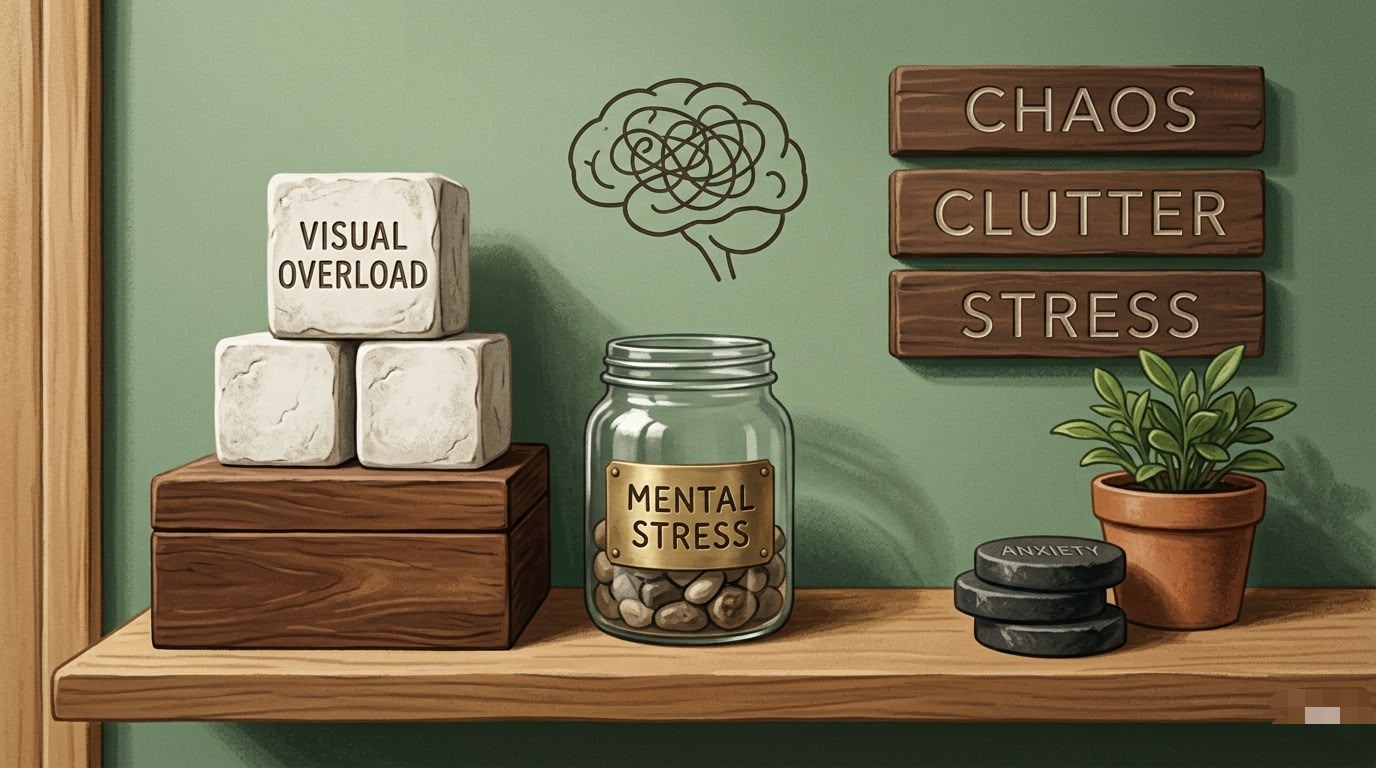
3. Can the Condition of Your Home Influence How You See Yourself?
A growing body of environmental psychology research suggests that people often view their living spaces as extensions of themselves.
A 2021 study involving 1,111 participants found that subjective clutter was significantly associated with lower well-being, while feelings of attachment and comfort within the home were linked with better psychological outcomes.
This finding reveals something many people intuitively sense but rarely articulate. Over time, the condition of a frequently used environment can begin influencing personal identity. A neglected space may reinforce feelings of being overwhelmed, while a cared-for environment can strengthen feelings of capability, stability, and self-respect.
The room is not defining the person, but it can influence the story the person repeatedly tells themselves.
4. Why Do Researchers Call the Home a Psychological Environment Rather Than Just a Physical Space?
For decades, homes were viewed primarily as physical shelters. Today, many environmental psychologists view them differently.
Research on the concept of “psychological home” suggests that people derive emotional security, identity, belonging, and meaning from the spaces they inhabit. A home is therefore not just a location where life happens. It becomes part of the mental framework through which life is experienced.
This perspective helps explain why disorder often feels larger than a cleaning problem. The issue is rarely about a pile of belongings in isolation. The deeper issue is the effect that environment has on clarity, ownership, stability, and connection to one’s living space.
What This Reveals About the Real Weight of Clutter
Perhaps the most overlooked finding in environmental psychology is that people do not simply live in their surroundings; over time, their surroundings become part of the psychological conditions under which they think, feel, and make decisions.
It can create unfinished mental loops, weaken feelings of control, influence self-perception, and alter the relationship people have with their homes.
Seen this way, the question is no longer why a messy room feels stressful.
A more revealing question emerges.
If people understand that their environment affects them this deeply, why do so many still struggle to clean or organize their space when they need it most?
The answer lies less in the room itself and more in the psychology of overwhelm, which is exactly what we will explore next.
Why Is It So Hard to Clean My Room When I’m Mentally Exhausted? 4 Psychological Barriers That Make Taking Action Feel Overwhelming
By this point, the connection between household disorder and mental health is becoming clear. Yet a frustrating question remains. If people understand that their environment affects their focus, emotions, and well-being, why do they often struggle to clean it? Modern psychology suggests the answer is not laziness. More often, it is a combination of overwhelm, decision fatigue, perfectionism, and avoidance working together beneath conscious awareness.
1. Why Does Overwhelm Make Small Cleaning Tasks Feel Much Bigger Than They Are?
One of the most common effects of mental exhaustion is a reduced ability to break large problems into manageable actions.
When people look at an entire room that feels neglected, the brain rarely sees individual tasks. Instead, it perceives one large unresolved problem. This creates what psychologists call overwhelm, a state in which the perceived size of a task exceeds the mental resources available to address it.
Research published in the International Journal of Environmental Research and Public Health involving 227 adults found that higher levels of household clutter were associated with greater procrastination and reduced quality of life. The important insight is that people often delay action not because a task is objectively difficult, but because it feels psychologically larger than it actually is.
2. Why Do We Freeze When There Are Too Many Decisions to Make?
Cleaning is often mistaken for a physical task when it is actually a decision-making task.
Every object requires a choice. Keep it, move it, organize it, donate it, store it, or discard it. Individually, these decisions seem insignificant. Collectively, they create a substantial cognitive burden.
Psychologist Barry Schwartz’s work on decision overload demonstrated that increasing the number of choices can reduce action and increase avoidance. This helps explain why people may walk into a crowded room fully intending to clean, only to leave feeling stuck. The obstacle is often not effort. It is the accumulation of hundreds of small decisions competing for attention at the same time.
Psychologists sometimes refer to this as cognitive load, where the brain becomes so occupied with processing choices that taking action feels harder than postponing it.
3. Can Perfectionism Secretly Stop You From Getting Started?
Many people believe perfectionism leads to productivity. Research often shows the opposite.
A study involving 206 participants found that maladaptive perfectionism was significantly associated with higher levels of procrastination. When individuals believe a task must be completed perfectly, starting becomes psychologically risky because anything less than perfection feels like failure.
This creates a hidden trap. The desire to organize everything correctly can become the very reason nothing happens at all. Progress requires action, but perfectionism frequently delays action until ideal conditions appear, conditions that rarely arrive.
4. Why Does Avoiding the Mess Make It Feel Even Worse Over Time?
Avoidance creates temporary relief.
That relief is precisely why the habit becomes so powerful.
When people postpone dealing with a difficult environment, anxiety often decreases for a short period. However, the underlying problem remains unchanged. Over time, the room becomes more difficult to manage, the task appears larger, and the emotional discomfort grows stronger.
As people withdraw from an overwhelming environment, they often stop engaging with the space altogether, opening windows less frequently, postponing maintenance, and spending less attention on the conditions that make a home feel mentally restorative.
Psychologists refer to this pattern as negative reinforcement. The brain learns that avoidance provides immediate comfort, even when it creates greater stress in the future. What begins as a short-term coping strategy can gradually become a self-perpetuating cycle that feels increasingly difficult to break.
What This Reveals About Motivation and Cleaning
Perhaps the most important insight is that struggling to clean an overwhelming space is often a psychological challenge before it becomes a practical one.
Overwhelm magnifies the task. Decision fatigue slows action. Perfectionism raises the starting threshold. Avoidance reinforces the cycle.
Understanding these mechanisms changes the conversation entirely. The goal is no longer to force motivation through guilt or self-criticism. The goal is to create conditions that make action feel easier than avoidance.
And that raises the final question. If the problem is not a lack of willpower, what practical changes actually help people regain a sense of calm, control, and momentum in their living space?
How Can I Make My Home Feel Calmer and More Positive? 5 Evidence-Based Changes That Support Mental Well-Being
If there is one encouraging lesson from psychology, it is this: the same environment that contributes to overwhelm can also become part of the solution.
Research consistently shows that small changes in surroundings often create disproportionately large improvements in mental well-being because the brain responds to its environment every day, not just when we consciously notice it.
The goal is not to create a perfect home. The goal is to create a home that makes calm, focus, and consistency easier to sustain.
1. Which Small Change Can Make a Home Feel Calmer Almost Immediately?
When people feel overwhelmed, they often assume they need a complete reset. In reality, the opposite approach is usually more effective.
Start with one visible surface, one drawer, or one corner of a room. Completing a small task provides the brain with evidence that progress is possible. Psychologist Teresa Amabile’s research on the “progress principle” found that even small wins can meaningfully improve motivation and emotional state.
The practical step is simple: choose one area that can be completed in less than fifteen minutes and finish it fully before moving elsewhere. Momentum is often built through completion, not ambition.
The brain gains confidence from evidence, and every completed task becomes evidence that progress is already underway.
2. How Can You Reduce Visual Friction Without Reorganizing Your Entire Home?
Many people try to organize everything at once and quickly burn out. A more sustainable approach is to reduce visual friction first.
Begin by removing items that do not belong in the room, clearing overcrowded surfaces, and assigning frequently used belongings to designated storage spaces. Research from Princeton University found that excessive visual stimuli compete for neural representation, making it harder to focus on relevant information.
This is why a room often feels calmer before it becomes perfectly organized. The brain experiences relief when visual competition decreases.
Simple tools such as clear storage containers, drawer organizers, and labeled baskets can help maintain that clarity without requiring constant effort.
3. How Can Natural Light and Fresh Air Make a Home Feel More Positive?
Mental well-being is influenced by more than organization. The physical conditions of a home matter as well.
Research published in the Journal of Clinical Sleep Medicine found that individuals with greater exposure to natural daylight reported better sleep quality, improved quality of life, and healthier daily functioning.
A practical approach is to open curtains early in the day, allow natural light into frequently used areas, and create opportunities for fresh air circulation whenever possible. Even a few minutes of ventilation can make a noticeable difference in how a room feels.
Sometimes what people describe as positive energy is simply the effect of a healthier environment supporting a healthier mind.In other words, before changing how a room looks, it is often worth changing the quality of light and air within it. The brain experiences those conditions long before it notices decorative improvements.
For people living in apartments with limited ventilation or restricted access to natural sunlight, supportive measures such as improving airflow, using an air purifier, or introducing indoor greenery can help create a healthier indoor environment. While they do not replace fresh outdoor air, they can contribute to a space that feels noticeably more comfortable and restorative.
4. Why Does the Emotional Atmosphere of a Home Matter as Much as Its Physical Condition?
A home is not experienced solely through sight. It is experienced through emotion.
Environmental psychology suggests that people form powerful emotional associations with the spaces they inhabit. The same room can feel restorative or exhausting depending on the experiences repeatedly attached to it.
Creating a calmer environment therefore involves more than organizing belongings. It also involves protecting the quality of interactions occurring within that space.
One practical habit is intentionally creating moments of calm each day, whether through a quiet morning routine, shared meals, reflection, gratitude, or uninterrupted conversation. These experiences gradually shape how the environment is perceived.
Over time, the brain begins anticipating the emotional experience associated with a space, which is why some environments feel calming before anything actually happens within them.
Because people responds not only to the physical condition of a home but also begin responding to the emotional memories attached to it. This is why two homes of similar size and design can create completely different psychological experiences.
5. What Habits Help a Home Feel More Peaceful, Orderly, and Abundant Over Time?
Across many traditions, prosperity was rarely associated with luxury alone. More often, it was associated with stewardship, the ability to care responsibly for one’s surroundings, relationships, and resources.
Modern psychology arrives at a surprisingly similar insight. Research consistently links orderly environments with stronger feelings of control, better habit maintenance, and improved decision-making. These qualities do not guarantee success, but they often create conditions that support it.
This perspective offers a more grounded way to understand traditional ideas connecting cleanliness, abundance, and Lakshmi. The deeper message may not be that prosperity appears because a home is tidy. It may be that caring for one’s environment cultivates the habits, awareness, and consistency that allow prosperity to grow.
Perhaps that is why so many traditions linked abundance with order. Not because wealth magically follows cleanliness, but because the mindset required to care for a space is often the same mindset required to build something valuable over time.
The Real Goal Was Never a Perfect Home
The most meaningful transformation is not the appearance of a room. It is the experience of living within it.
When visual distractions are reduced, when natural light and fresh air are welcomed, when systems simplify daily life, and when the atmosphere supports emotional well-being, a home begins contributing to mental health rather than quietly draining it.
Perhaps that is the most practical definition of positive energy: a space that consistently helps you think more clearly, act more intentionally, and live with greater ease.
Conclusion: The Calm You Are Looking for May Begin at Home
A messy room does not create anxiety on its own, but it can quietly amplify the mental load you are already carrying. The encouraging news is that even small changes to your surroundings can create meaningful shifts in focus, emotional balance, and daily well-being.
A calmer home is rarely built through perfection. It is built through simple habits, supportive environments, and intentional care. When your space becomes easier to live in, your mind often becomes easier to live with too.